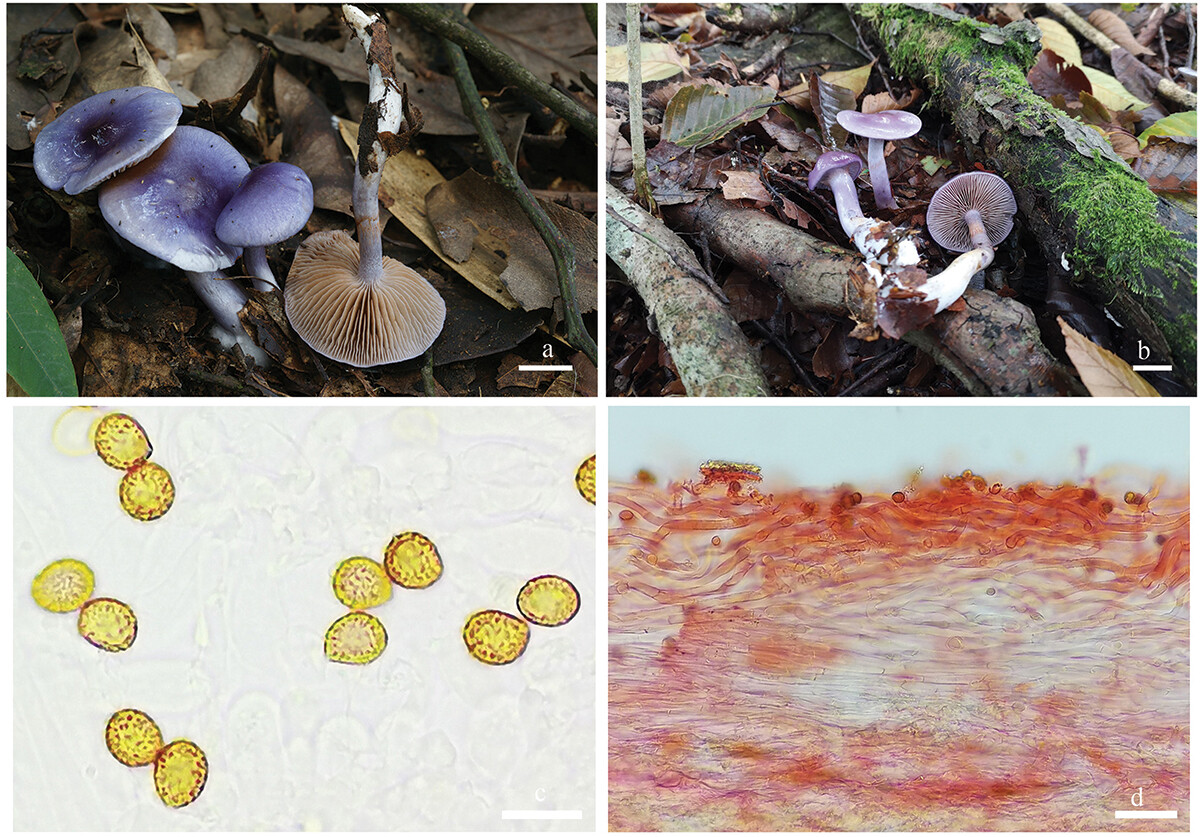
Cortinarius sinosalor P. Long, M.L. Xie & Z.H. Chen, sp. nov., Figure 5
Fungal Names: FN 572060.
Diagnosis: Similar to C. subsalor in sect. Delibuti but differs in its more distinct violaceous to bluish violet pileus.
Typification: CHINA. Hunan Province, Dong’an County, in broad-leaved forest, 14 September 2010, Zuo-Hong Chen, Ping Zhang, MHHNU 30649.
Etymology: Named after the species morphologically similar to Cortinarius salor, and the geographical distribution range of China.
Description: Pileus 10–30 mm, hemispherical at first, then convex with a low umbo to plane, violaceous (16A2-16A4) to bluish violet (17A4-17B4) and the colour is deep in the centre at first, becoming violet white (16A2-17A3) to yellow brown (4B5-4C7), surface glutinous. Lamellae adnexed; moderately crowded, violaceous (16A1-16A2) to bluish violet (17A2-17B2), later brown (5B4-5C7), edge usually incurved. Stipe 40–70 mm long, 4–10 mm thick, cylindrical to clavate, whitish to lilac (16A2-17A3) with fibrillose at the apex, surface covered bluish violet (17A4-17B4) universal veil, basal mycelium white (−A1), solid initially, then hollow. Universal veil glutinous, bluish violet (17A4-17B4). Context violet (16A2-17A2) at the pileus, later greyish violet (17B2) to white (−A1). Odour indistinct.
Basidiospores 7.4–9.0 × 6.0–7.7 µm, Q = 1.07–1.38, Xav. = 8.2–8.3 × 6.6–7.0 µm, Qav. = 1.19–1.27, subglobose to broadly ellipsoid, coarsely verrucose. Basidia 25–33 × 7–9 µm, clavate, colourless, or amber yellow oily liquid. Lamellar edges fertile. Cystidia absent. Pileipellis: epicutis strongly gelatinous, about 75–125 µm thick, hyphae 4–8 µm wide, colourless in 5% KOH, hyphae irregularly to subparallel arranged and weakly interwoven, almost smooth. Hypodermium present, hyphae 8–28 µm wide, slightly yellow in 5% KOH, and smooth. Clamp connections present.
Ecology and distribution: In subtropical coniferous and broad-leaved mixed forests or evergreen broad-leaved forests. Known from Hunan, Hubei, and Zhejiang, China.
Other specimens examined: CHINA. Hubei Province, Hefeng County, 110°21′07″ N, 30°13′29″ E, alt. 1,283 m, 2 August 2016, Zuo-Hong Chen, Pan Long, Sai-Nan Li, MHHNU 31705. Hunan Province, Sangzhi County, Badagongshan National Nature Reserve, 29°76′92″ N, 110°08′66″ E, alt. 1,405–1,482 m, 20 September 2019, Zuo-Hong Chen, Pan Long, Sai-Nan Li, MHHNU 31617; 27 July 2020, Zuo-Hong Chen, Pan Long, Sai-Nan Li, MHHNU 31926; 30 July 2022, Zuo-Hong Chen, Jing Wen, Zi-Juan Jiang, MHHNU 33540; 1 August 2015, Ping Zhang, MHHNU 8572, MHHNU 8597. Zhejiang Province, Lishui City, Qingyuan County, Baishanzu National Park, in mixed forest, 27°44′14″ N, 119°10′49″ E, 13 August 2023, Yong Zhou, HMJAU 58971.
Notes: Cortinarius sinosalor is characterised by glutinous basidiomata, violaceous to bluish violet pileus, bluish violet universal veil, subglobose to broadly ellipsoid basidiospores, on average 8.2–8.3 × 6.6–7.0 µm. The ITS of MHHNU 8572, MHHNU 30649, and HMJAU 58971 differs in the type sequence by three indels and 4–7 substitutions, but the morphological characteristics of these specimens are consistent with the other specimens. This species is easily confused with other species in sect. Delibuti in morphology. However, the ITS sequences of C. sinosalor differed from those of the other species in sect. Delibuti by at least 40 substitutions and indel positions and formed well-defined species clustered with C. fibrillososalor, C. subtropicus, and C. tibeticisalor in the phylogenetic tree.
参考翻译:
Cortinarius sinosalor P. Long, M.L. Xie & Z.H. Chen, sp. nov., 图 5
Fungal Names:FN 572060。
特征集要:相似于 C. subsalor(Delibuti 组),但区别在于其更明显的紫罗兰色至蓝紫色菌盖。
模式标本:中国。湖南省东安县,阔叶林中,2010年9月14日,陈作红、张平,MHHNU 30649。
词源:以形态上相似于 Cortinarius salor 的物种及其在中国的地理分布范围命名。
描述:菌盖 10–30 mm,初半球形,后凸起至平展,具低凸脐,紫罗兰色(16A2-16A4)至蓝紫色(17A4-17B4),中心初色深,后变为紫白色(16A2-17A3)至黄褐色(4B5-4C7),表面胶质。菌褶弯生,中等密,紫罗兰色(16A1-16A2)至蓝紫色(17A2-17B2),后变褐色(5B4-5C7),边缘常内卷。菌柄长 40–70 mm,粗 4–10 mm,圆柱形至棒状,顶部近白色至淡紫色(16A2-17A3),具纤维状,表面覆盖蓝紫色(17A4-17B4)的外菌幕,基部菌丝白色(−A1),初实心,后中空。外菌幕胶质,蓝紫色(17A4-17B4)。菌肉在菌盖处紫罗兰色(16A2-17A2),后变灰紫色(17B2)至白色(−A1)。气味不明显。
担孢子 7.4–9.0 × 6.0–7.7 µm,Q = 1.07–1.38,Xav. = 8.2–8.3 × 6.6–7.0 µm,Qav. = 1.19–1.27,近球形至宽椭圆形,具粗疣。担子 25–33 × 7–9 µm,棒状,无色,或含琥珀黄色油状液体。菌褶缘可育。囊状体缺如。菌盖皮层:表皮层强胶质化,约 75–125 µm 厚,菌丝宽 4–8 µm,在 5% KOH 中无色,菌丝不规则至近平行排列且弱交织,几乎光滑。下皮层存在,菌丝宽 8–28 µm,在 5% KOH 中微黄色,光滑。锁状联合存在。
生态与分布:亚热带针阔混交林或常绿阔叶林中。已知分布于中国湖南、湖北和浙江。
其他研究标本:中国。湖北省鹤峰县,110°21′07″ N,30°13′29″ E,海拔 1,283 m,2016年8月2日,Zuo-Hong Chen、Pan Long、Sai-Nan Li,MHHNU 31705。湖南省桑植县,八大公山国家级自然保护区,29°76′92″ N,110°08′66″ E,海拔 1,405–1,482 m,2019年9月20日,Zuo-Hong Chen、Pan Long、Sai-Nan Li,MHHNU 31617;2020年7月27日,Zuo-Hong Chen、Pan Long、Sai-Nan Li,MHHNU 31926;2022年7月30日,Zuo-Hong Chen、Jing Wen、Zi-Juan Jiang,MHHNU 33540;2015年8月1日,Ping Zhang,MHHNU 8572,MHHNU 8597。浙江省丽水市庆元县,百山祖国家公园,混交林中,27°44′14″ N,119°10′49″ E,2023年8月13日,Yong Zhou,HMJAU 58971。
备注:Cortinarius sinosalor 的特征为胶质担子果、紫罗兰色至蓝紫色菌盖、蓝紫色外菌幕、近球形至宽椭圆形的担孢子,平均 8.2–8.3 × 6.6–7.0 µm。MHHNU 8572、MHHNU 30649 和 HMJAU 58971 的 ITS 序列与模式序列相差 3 个插入缺失和 4–7 个替换,但这些标本的形态特征与其他标本一致。本种在形态上易与 Delibuti 组的其他种类混淆。然而,C. sinosalor 的 ITS 序列与 Delibuti 组其他种类至少有 40 个替换和插入缺失位点的差异,并在系统发育树中与 C. fibrillososalor、C. subtropicus 和 C. tibeticisalor 聚成明确的分支。