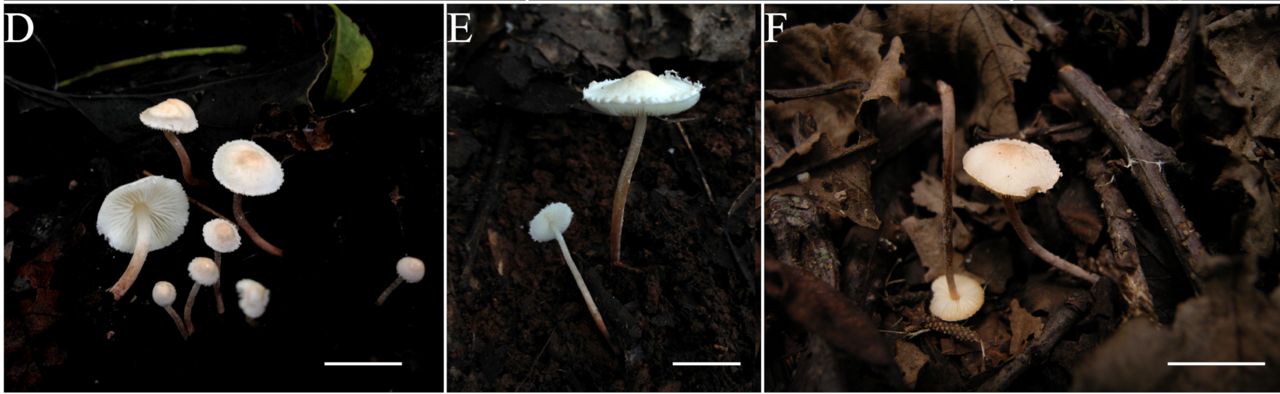
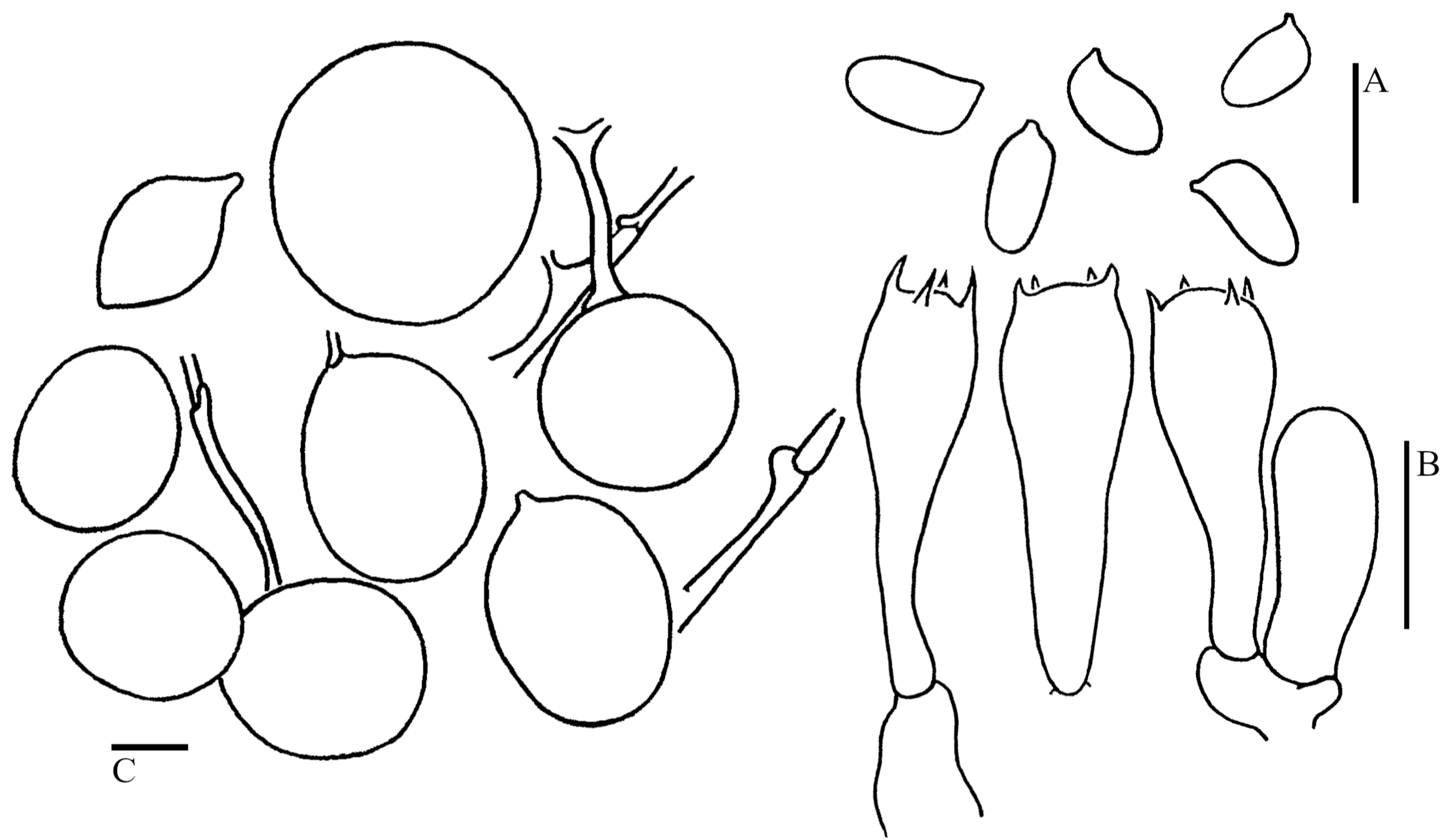
Cystolepiota seminuda (Lasch) Bon, Documents Mycologiques 6(24): 43, 1976. Figure 3D–F, Figure 4E–G and Figure 8.
≡ Agaricus seminudus Lasch, Linnaea 3: 157, 1828 (Basionym).
≡ Lepiota seminuda (Lasch) P. Kumm., Führ. Pilzk. (Zerbst): 136, 1871.
≡ Lepiota sistrata var. seminuda (Lasch) Quél., Mém. Soc. Émul. Montbéliard, Sér. 2 5: 231, 1872.
≡ Cystoderma seminudum (Lasch) Fayod, Annls Sci. Nat., Bot., sér. 7 9: 351, 1889.
≡ Mastocephalus seminudus (Lasch) Kuntze, Revis. gen. pl. (Leipzig) 2: 860, 1891.
= Lepiota seminuda f. minima J.E. Lange, Fl. Agaric. Danic. 1: 36, 1935 (Nom. inval.).
= Lepiota sistrata f. minima J.E. Lange ex Babos, Annls hist.–nat. Mus. natn. hung. 50: 91, 1958 (Nom. inval.).
Neotypification: Germany, Saxony, Zwickau, Helmsdorf-Nord, edge of the forest, 10 October 2007, H. Jurkschat (GLM-F125824, neotype designated here), MycoBank: MBT10008384, GenBank: ITS = OL898735.
Description: Pileus 2.5–12 mm diam, first conical, paraboloid to hemispherical, then expanding to plano-convex or convex, often with a broad umbo at the center; surface white, when young, changing to light cream with age, covered with densely powdery to granulose squamules, which become sparse or even disappear with age; light yellowish-brown (6C3-5), pinkish-orange to light pink (6A2-5) at the center of the pileus; white to cream towards the margin, fragile and easily breaking off; pileus margins often appendiculate with veil remnants. Lamellae up to 2(–3) mm wide, free, crowded, white to light cream, with 3–5 tiers of lamellulae. Stipe 10–45 mm long, 0.5–1.5 mm diam, central, subcylindrical to cylindrical; white to cream; glabrous in the upper part, gradually darkening towards the base, central and lower part grayish orange (6B5-7), brownish (5D6), reddish brown (7C6-7) to purplish brown (7F7), with white, light cream to light brownish powdery to granulose squamules, easily breaking off. Context thin (<1 mm), whitish. Smell not distinct; taste not recorded.
Basidiospores [160/8/7] (3–)3.5–4.5(–5) × (1.5–)2–2.5(–3) μm, Q = (1.41–)1.46–2.15(–2.45), Qm = 1.78 ± 0.22, ellipsoid to elongate; inamyloid, non-dextrinoid, metachromatic in cresyl blue; colorless, surface smooth under LM and SEM (Figure 4E–G); apiculus small. Basidia (11–)13–18.5(–20) × (4–)5–6(–7) μm, clavate, 4-spored; sterigmata 1.5–3 μm long. Lamellar trama regular, composed of hyphae, 3–9 μm diam. Pleurocystidia and cheilocystidia absent. Squamules composed of loosely arranged globose, subglobose, ellipsoid, or sometimes sphaeropedunculate cells, 16–41 × 14–35 µm and slender hyphae, 1–4 µm in diam, smooth-walled, thick-walled, colorless. Clamp connections present in all tissues (Figure 8).
Habitat and distribution: solitary or scattered on soil, rotten leaves, or between moss, distributed in temperate and subtropical zones of the Northern Hemisphere (China, Estonia, Germany, USA).
Additional specimens examined: China, Yunnan Province, Kunming City, Golden Temple, 14 June 2008, Z.W. Ge 2014 (KUN-HKAS 54210); ibid., Z.W. Ge 2015 (KUN-HKAS 54211); Kunming Botanical Garden, 28 October 2017, Z.W. Ge 4102 (KUN-HKAS 106016); Xiaoshao, 25 October 2017, Z.W. Ge 4094 (KUN-HKAS 106008); Xizang (Tibet) Autonomous Region, Qamdo Prefecture, Mangkang (Markam) County, alt. 3302 m, 4 August 2013, Z.W. Ge 3437 (KUN-HKAS 84275). Estonia, Viljandi S, Loodi, 17 August 1989, G. Zschieschang (GLM-F040567); Heimtali, 17 August 1989, G. Zschieschang (GLM-F040540). Germany, North Rhine-Westphalia, Lohmar, Wahner Heide, 1 November 2016, K. Wehr (GLM-F109912); Saxony, Görlitz-Biesnitz, Landeskrone, under Fagus, 15 September 1996, G. Zschieschang (GLM-F036422); Saxony Herrnhut, Hutberg, under Tilia and Quercus, 27 September 2001, G. Zschieschang (GLM-F042189).
Notes: Agaricus seminudus, the basionym of Cystolepiota seminuda, was described in the Margraviate of Brandenburg (not identical with the contemporary state of Brandenburg), Germany [23]. As no holotype specimen of A. seminudus was designated, specimens previously collected in Germany that had been identified as C. seminuda based on morphology were studied. The ITS sequences of these specimens confirmed the placement of this species in the genus Cystolepiota. However, these specimens belonged to four clades, suggesting the existence of four species. Two of them clustered with sequences from GenBank that had been generated from specimens identified as C. seminuda as well and represent two different species. The basidiospores of the specimens of one species were observed to be ornamented under the SEM, while those of another species were smooth-walled. We regard the latter species as C. seminuda because it includes specimens that had been collected closest to the type location and most of the German specimens belonged to it. Moreover, these specimens were presumably growing on soil, two specimens from Estonia were even collected between moss described as the habitat of A. seminudus in the protologue of the species. As the holotype was neither located in ZE Botanischer Garten und Botanisches Museum, Freie Universität Berlin (B), where the type specimens of G. W. Lasch had been deposited, nor in other collections holding specimens collected by Lasch (https://www.sil.si.edu/DigitalCollections/tl-2/history.cfm (accessed on 1 December 2022)), one of the specimens closest to the type location (GLM-F125824) is designated here as a neotype of A. seminudus. In contrast, the two German specimens from the clade with ornamented basidiospores were apparently growing on wood and related to C. pseudoseminuda, which is a species newly described in this study.
Compared with C. seminuda, L. sororia and L. rufipes, which have been reduced to synonyms of C. seminuda by Vellinga in 1987 and 2010 respectively, have larger basidiomata and longer and narrower basidiospores [21,33,36,59]. Furthermore, L. sororia forms larger basidiomata [33] and both the pileus and stipe of L. rufipes were described as smooth and glabrous [59], although Vellinga (2010) inferred that it may be the result of rain washing [36]. Accounting for the difference described above, we temporarily remove L. sororia and L. rufipes from synonyms of C. seminuda until specimens exactly matching the description of the protologue of the two species are found and sequenced.
Cystolepiota seminuda (Lasch) Bon, DocumsMycol. 6(no. 24): 43, 1976.
= Agaricus granulosus var. rufescens Berk. &Broome, Ann. Mag. nat. Hist. Ser. 57: 124,1881.
= Agaricus seminudus Lasch, Linnaea3: 157,1828.
= Cystoderma seminudum (Lasch) Singer, 1945.
= Lepiota seminuda (Lasch) P. Kummer, Führ.Pilzk. (Zwickau) 136, 1871.
= Lepiota sororia Huijsman, Persoonia 1(3): 326,1960. (Fig. 3)
Pileus 1-1.5 cm, conic-campanulate when young,later plane, surface white-powdered, marginsmooth, sometimes with hanging veil remnants.Lamellae free, white, with lamellulae, edgessmooth. Stipe 1.5-2 x 0.1-0.15 cm, cylindrical,hollow, white-powdered, dark-red when bruised.Annulus white, membranous, pendulous. Fleshwhite, thin. Spores broadly elliptical, hyaline,smooth, 3.5-4 x 2-2.5 μm. Basidia clavate, 12-15x 6-7 μm, with 4 sterigmata. Cheilocystidia notobserved. Pileipellis composed of subglobosecells, septa without clamps.
Habitat: On soils.
Specimens examined: Taichung: NMNS, W. N.Chou, CWN 08737, July 14, 2009; Taichung:NMNS, W. N. Chou, CWN 09009, Oct. 6, 2009.Distribution: Asia, Europe, North America, NorthAfrica.
Notes: This small mushroom is relativelycommon in Taichung. Its spores are very small.The general characteristics of Cystolepiotaare that the spores are not dextrinoid, and thepileipellis is composed of globose cells (Imazekiand Hongo, 1987; Bi, et al., 1994; Breitenbachand Kränzlin, 1995).
参考翻译:
菌盖直径1-1.5厘米,幼时圆锥形至钟形,后平展,表面覆白色粉状物,边缘光滑,有时具悬垂的菌幕残留。菌褶离生,白色,具小菌褶,边缘光滑。菌柄1.5-2 × 0.1-0.15厘米,圆柱形,中空,覆白色粉状物,受伤后变深红色。菌环白色,膜质,下垂。菌肉白色,薄。孢子宽椭圆形,透明,光滑,3.5-4 × 2-2.5微米。担子棒状,12-15 × 6-7微米,具4个小梗。褶缘囊状体未观察到。菌盖皮由近球形细胞组成,隔膜无锁状联合。
生境:生于土壤上。
研究标本:台中:国立自然科学博物馆,周文能,CWN 08737,2009年7月14日;台中:国立自然科学博物馆,周文能,CWN 09009,2009年10月6日。
分布:亚洲、欧洲、北美、北非。
附注:此种小型蘑菇在台中较为常见。其孢子非常小。囊小伞属的一般特征是孢子非糊精质,菌盖皮由球形细胞组成。