Lepiota venenata Z. H.Chen & Zhu L. Yang, sp. nov. MycoBank: MB 824765. Etymology:“venenatus” means poisonous. Type: Jingzhou City,Hubei Province,China, alt.200-300 m,2017-09-10Z.H.Chen 31031(holotype, HKAS 101874; isotype, MHHNU31031).
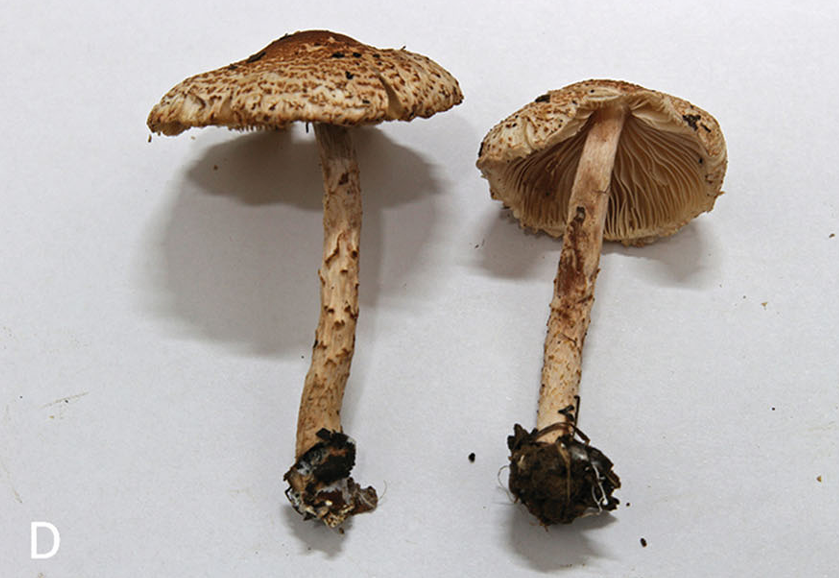
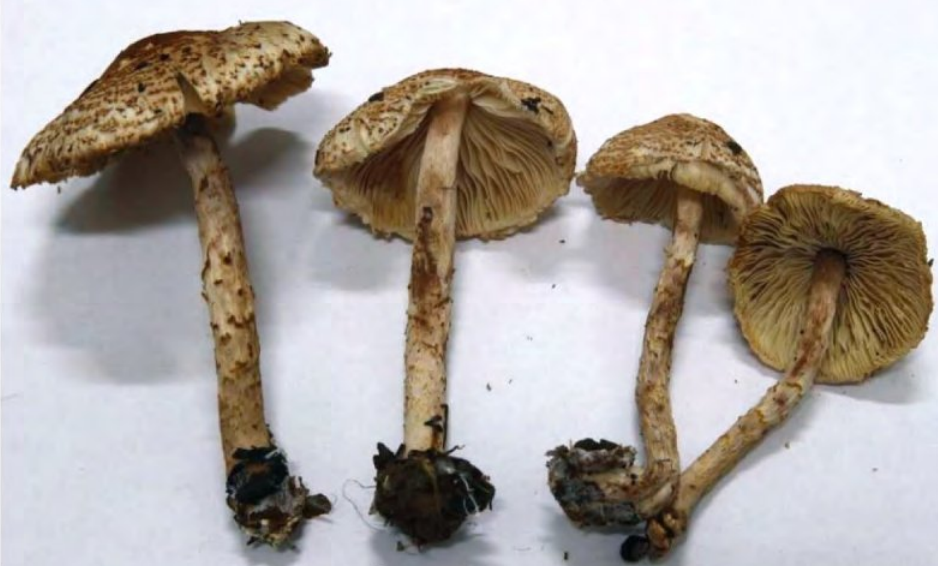
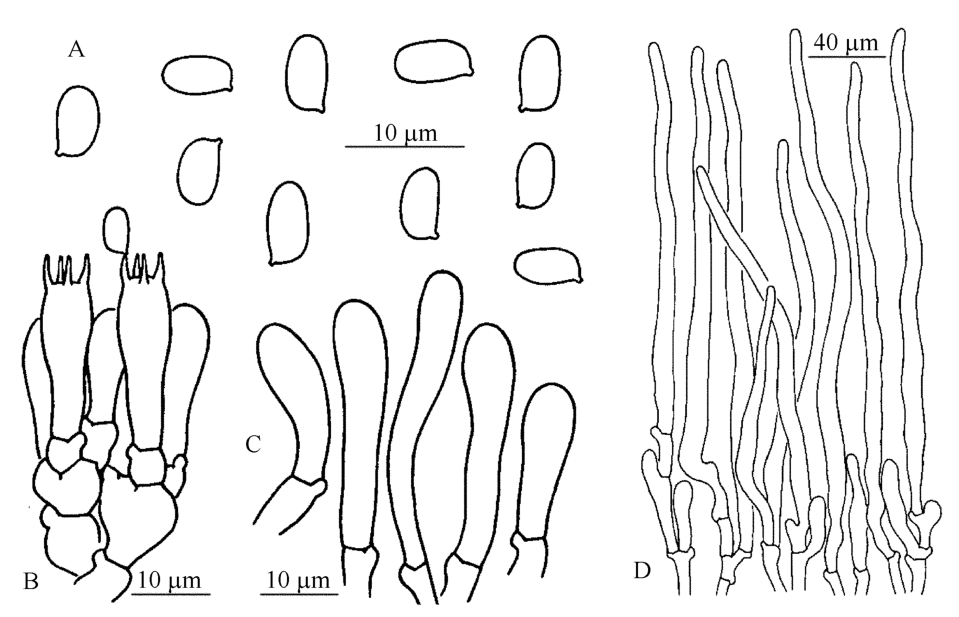
Description: Basidiomata(Fig.2) small to me- dium-sized. Pileus 3-6 cm in diam, convex to applanate,broadly umbonate; surface dry, dirty white to cream [4A1-4A2],densely covered with brown to occasionally reddish brown[7E2-7E2],somewhat reflexed squamules; center brown to dark brown; margin incurved, appendiculate,often with remnants of annulus. Lamellae free to subfree,white to cream- colored [2A2-3],moderatelycrowded;lamellulae attenuate,arranged in 2-3 tiers,evenly distributed; edges whitish,denticulate. Stipe7-9 x 0.5-1cm, subcylindrical, dry,dirty white[4A1-4A2],lower part covered with brown to reddish brown squamules, forming incomplete girdles,fistulose; annulus fugacious. Context white, solid. Taste and odour unknown. Lamellar trama regular, composed of colorless thin-walled hyphae 3-12 um in diam,branching, sometimes anastomosing; clamps present and common. Subhymenium about 15-20 um thick composed of inflated cells; clamps common. Basidia(Fig.3-B)20-25x6.5-7.5 μm,clavate,4- spored,rarely 2-spored,hyaline; sterigmata 3-4(5)um long; basal septa often with clamps. Basidi- ospores(Fig.3-A)[60/3/2](5-)5.5-6.5(-7)x3-3.5(-4)um [mean length = 5.9 μm, mean width=3.4μm,Q=(1.45-)1.57-2.00(-2.03),Q = 1.77± 0.14],mostly elongate, occa- sionally ellipsoid or cylindrical,colorless,hyaline, slightly thick-walledsmooth,without suprahilar de pression, without germ pore, dextrinoid, not meta- chromatic in Cresyl Blue; apiculus small.Pleurocystidia absent. Cheilocystidia(Fig3-C)20-38x5-7 μm,scattered along the lamellar edge,narrowly clavate, thin-walled,colorless and hyaline. Squamules on pileus(Fig.3-D)a trichoderm,com- posed of loosely and more or less vertically arranged elements,200-320x8-14 μm; elements lanceolate to subcylindrical, narrower in basal part, broader in lower part,attenuate upwards, with pari- etal,brown pigment; underlayer well developed made up of subcylindrical to narrowly clavate ele- ments,30-80x8-12 um,with parietalbrown pigment. Clamps common in all parts of basidioma. Habit, habitat, and distribution:Solitary to scattered, on soil in forests with broad-leaved trees; fruiting in summer and autumn in central China.
Discussion:The ITS sequence retrieved from- GenBank labeled with the name “Lepiota sp. JN224826 Thailand”(MFLU09-0152)is nearly identical to that generated from the Chinese collection of L.venenata, and thus the material from Thailand should also belong to the new species. Therefore,L. venenata is distributed from central China to northern Thailand[31]. Lepiota venenata is a toxic mushroom and is very similar to the well-known toxic taxa L. brunneoincarnata and L. subincarnata,both of them orig inally described from Europe and also found in Chi- na[1-15].However,the latter two species usually have smaller basidiomata but larger basidiospores(references[32-33] and our own unpublished data). Furthermore,elements in the squamules on the pileus of the new species are usually lanceolate and broader in lower part and attenuate upwards. Lepiota venenata is somewhat similar to L. elaio phylla Vellinga & Huijser,which is also toxic.How- ever, the latter taxon has olive-yellow to grayish-olcivaceous yellow lamellae and significantly longer basidiospores(31,34]. Lepiota brunneolilacea and L. helveola are also very toxic.However,L. brunneolilacea is distinguished by its nearly glabrous stipe,significantly larger ba- sidiospores and clavate elements(broader in upper part) in the squamules on pileus.Lepiota helveola can be separated from L.venenata by its significantly larger basidiospores and much broader clavate to subfusiform elements (broader in middle and upper part) in the squamules on pileus.