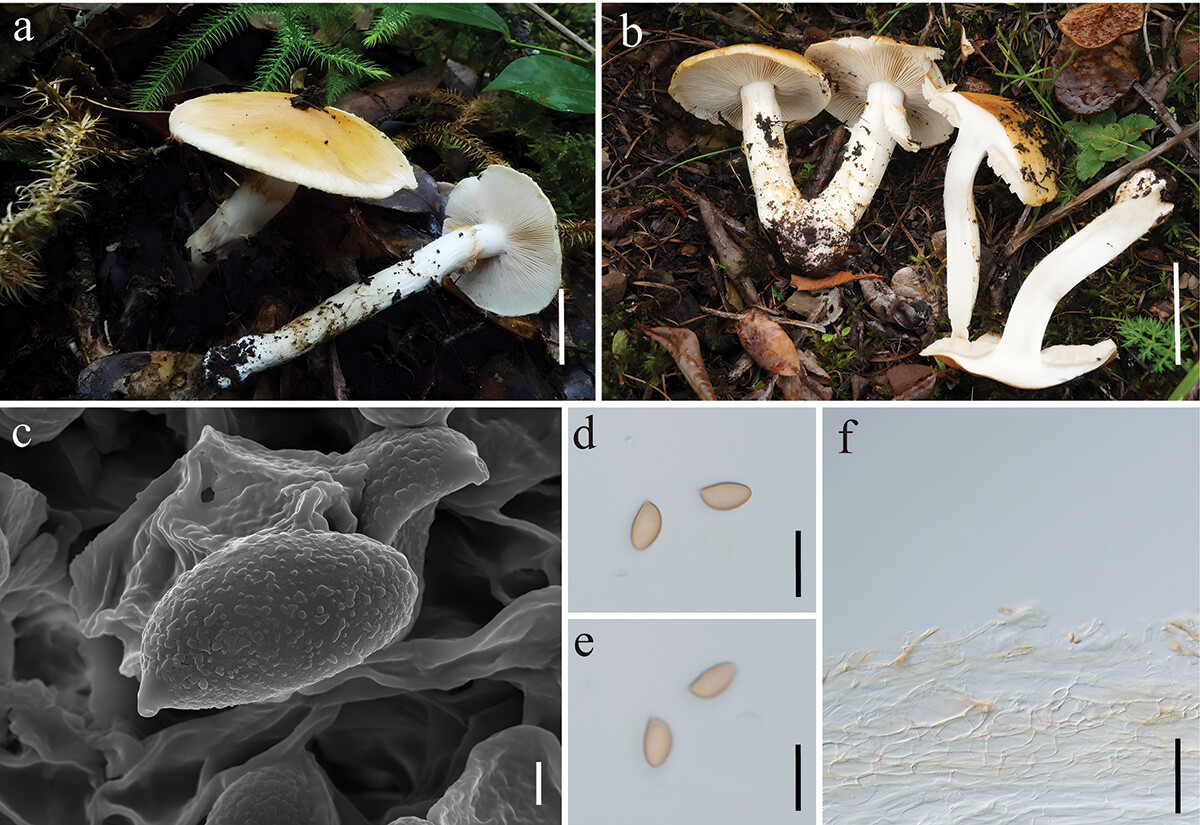
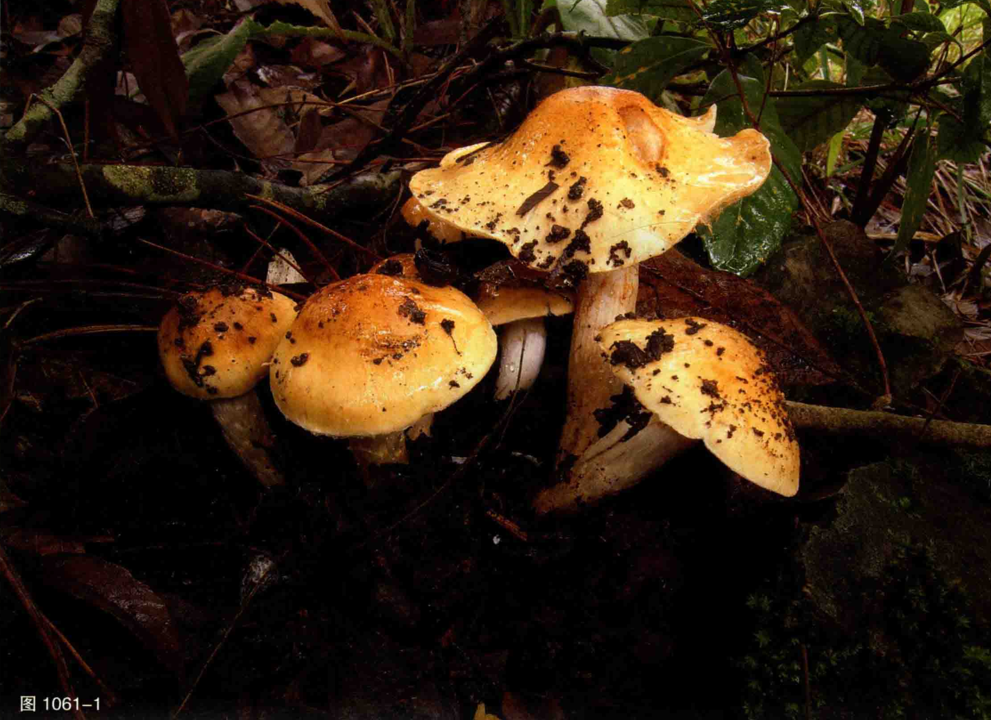
Thaxterogaster tenuipes (Hongo) Zhu L. Yang & Zi R. Wang, comb. nov. & stat. nov. Figure 16
Fungal Names: 572212.
Basionym: Cortinarius claricolor var. tenuipes Hongo, J. Jap. Bot. 44 (8): 232, Fig . 3/1 (1969).
Synonyms: Cortinarius tenuipes (Hongo) Hongo, Colored Illustrations of Mushrooms of Japan 1: 229, pl. 56/402 (1987) [invalid, Art. 41.5 (Shenzhen)].
Holotype: JAPAN, Ôtsu-city, Seta-chō, 24 October 1954, Hongo Herb. no 1081 (TNS-F237304).
Epitype: CHINA. Yunnan Province: Baoshan City, Tengchong County, Houqiao Town, in a subtropical broad-leaved forest with trees of Fagaceae, elevation 1,774 m, longitude and latitude 25.25196185 °N, 98.30713230 °E, 10 August 2011, Yan-Jia Hao 452 (KUN-HKAS 71561), here designated. GenBank: PQ013282.
Description: Basidioma medium-sized to large. Pileus 3–5 cm diam and hemispherical to convex when young, 7–12.5 cm diam and plano-convex when mature, viscid, pale yellow (4A2–4A4) (sometimes brown (5C8) towards the centre); margin covered with white (5A1) to ochraceous yellow (5B7) fibrillose squamules; context of pileus whitish (4A1) to greyish (4B1). Lamellae emarginate, crowded (L = 120–130, l = 10–15), dirty white (5A1–5B1), then brownish (5C2) to yellowish brown (4B3–4B5). Stipe 5–12 × 0.7–1 cm, cylindrical, rarely with a bulbous base, whitish (5A1), covered with pale brown (5B3) to brown (6C4–6C7) fibrillose squamules; context of stipe whitish (4A1) to greyish (4B1), brownish (6C4–6C7) when damaged; basal mycelium white (5A1), sometimes with pale violaceous tint (15A1).
Basidiospores [80/4/4] 6.5–8 × 3.5–5 μm, Q = 1.67–1.82, av. = 7.51 ± 0.69 × 4.13 ± 0.34 μm, Qav. = 1.82 ± 0.15, subamygdaliform, weakly verrucose, iodine reaction amyloid. Basidia 35–40 × 8–9 μm, 4-spored, clavate. Trama of lamellae regular, composed of colourless to pale orange, smooth hyphae 10–11.5 μm wide. Pileipellis duplex: epicutis 35–50 μm thick, gelatinous, composed of interwoven to parallel, smooth, thin-walled, long-celled hyphae 3–5 μm wide, with yellowish membrane pigmentation; hypocutis composed of interwoven to parallel, cylindrical, thin-walled hyphae 15–18.5 μm wide, with yellowish intracellular or membrane pigmentation. Clamp connections common in all parts of basidioma.
Habitat/host: Summer to autumn. Solitary to gregarious on soil in temperate to subtropical broad-leaved or coniferous or mixed forests with trees of the Fagaceae family and Pinus spp.
Distribution: Currently known from Japan, South Korea, and China (Hongo 1969; Hongo and Rokuya 1987; Namgung et al. 2001; Maeta et al. 2008; Yang et al. 2021; Shirakawa et al. 2022; Wang et al. 2022a, 2022c).
Other Specimens examined: CHINA. Yunnan Province: Baoshan City, Tengchong County, Houqiao Town, in a subtropical broad-leaved forest with trees of Fagaceae, elevation 1,774 m, longitude and latitude 25.25196185 °N, 98.30713230 °E, 10 August 2011, Gang Wu 606 (KUN-HKAS 74920); same City, Longyang District, Shui Township, in a subtropical broad-leaved forest with trees of Fagaceae, elevation 2,300 m, longitude and latitude 25.23950513 °N, 99.30879397 °E, 12 August 2011, Gang Wu 647 (KUN-HKAS 74961); same City, Longling County, Bajiaogou, in a subtropical broad-leaved forest with trees of Fagaceae, elevation 1,600 m, longitude and latitude 24.30636951 °N, 98.95715556 °E, 28 July 2022, Jin-Yan Tang 187 (KUN-HKAS 138526). Lijiang City, Lijiang Alpine Botanic Garden, in a temperate broad-leaved and coniferous mixed forest with trees of Quercus and Pinus, elevation 2,730 m, longitude and latitude 26.94931607 °N, 100.19683690 °E, 14 August 2013, Yang-Yang Cui 073 (KUN-HKAS 79749); same City, Gucheng District, Longshan Township, in a temperate coniferous forest with trees of Pinus, elevation 2,700 m, longitude and latitude 26.87151359 °N, 100.36638077 °E, 21 August 2010, Xue-Tai Zhu 270 (KUN-HKAS 68446); same City, Lijiang Alpine Botanic Garden, in a temperate broad-leaved and coniferous mixed forest with trees of Quercus and Pinus, elevation 3,521 m, longitude and latitude 27.00167917 °N, 100.17736238 °E, 7 August 2023, Zi-Rui Wang 142 (KUN-HKAS 135880); Pu’er City, Lancang Lahu Autonomous County, Fazhahe Village, in a subtropical coniferous forest with trees of Pinus, elevation 1,430 m, longitude and latitude 22.34024868 °N, 100.18440373 °E, 31 August 2017, Xiao-Bin Liu 813 (KUN-HKAS 101349); same place and date, in a subtropical broad-leaved forest with trees of Fagaceae, elevation 1,350 m, longitude and latitude 22.33694746 °N, 100.18217876 °E, Zhu-Liang Yang 6046 (KUN-HKAS 101235). Qujing City, Dongshan County, in a temperate broad-leaved and coniferous mixed forest with trees of Quercus and Pinus, elevation 2,100 m, longitude and latitude 25.24168240 °N, 104.06633056 °E, 12 August 2007, Zhu-Liang Yang 4913 (KUN-HKAS 52230).
Notes: Thaxterogaster tenuipes is characterised by its plano-convex, viscid, pale yellow pileus covered with white to ochraceous yellow fibrillose squamules, whitish cylindrical stipe with a white basal mycelium (sometimes with a pale violaceous tint), and small, subamygdaliform, weakly verrucose basidiospores.
Phylogenetically, T. tenuipes is closely related to T. turmalis (Fr.) Niskanen & Liimat. (Figure 1). Although the molecular phylogenetic divergence between the 2 species seems to be small but steady, they are therefore treated as different species due to their wide geographical separations. Morphologically, T. tenuipes differs from T. turmalis by its paler pileus without brownish innate stripes and spots, margin with abundant white fibrillose squamules, and slender stipe (Hongo 1969; Hongo and Rokuya 1987).
DNA sequences could not be successfully generated from the holotype of T. tenuipes (TNS-F237304) by Hosaka (2017), who had found the original label of this taxon under the name of C. claricolor. To fix the concept of this species, an epitype with multi-locus DNA sequences generated from it, was proposed here.
Thaxterogaster tenuipes is widespread in East Asia, and basidiomata of this species are edible (Namgung et al. 2001; Maeta et al. 2008; Yang et al. 2021; Shirakawa et al. 2022; Wang et al. 2022a, 2022c).