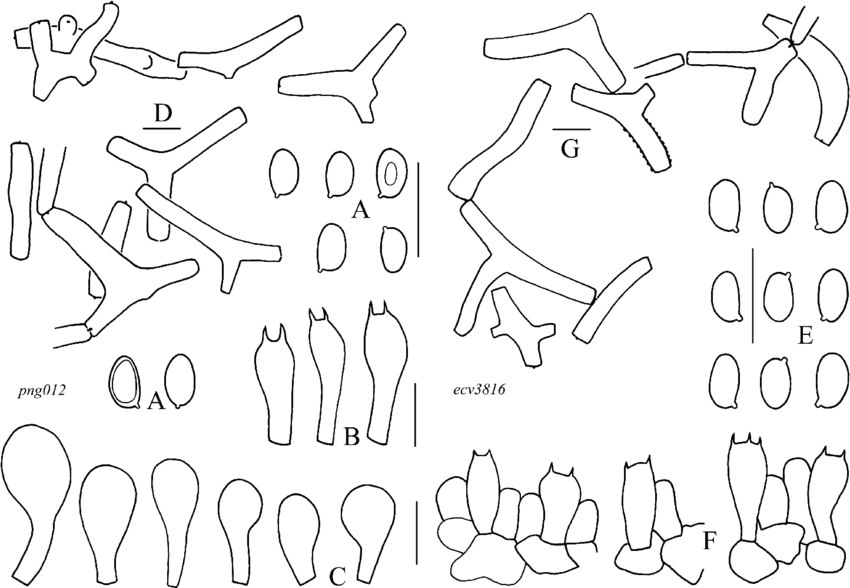
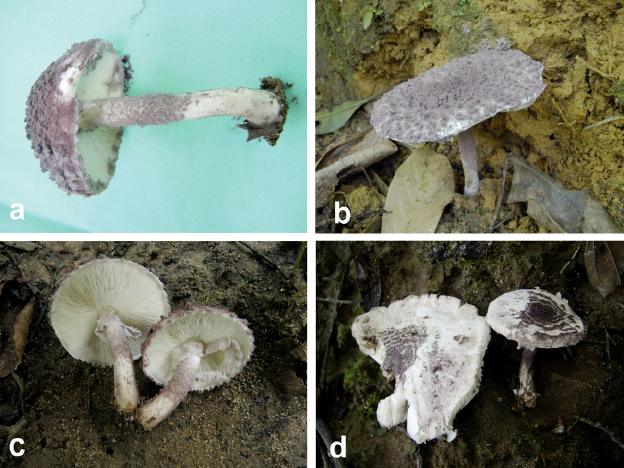
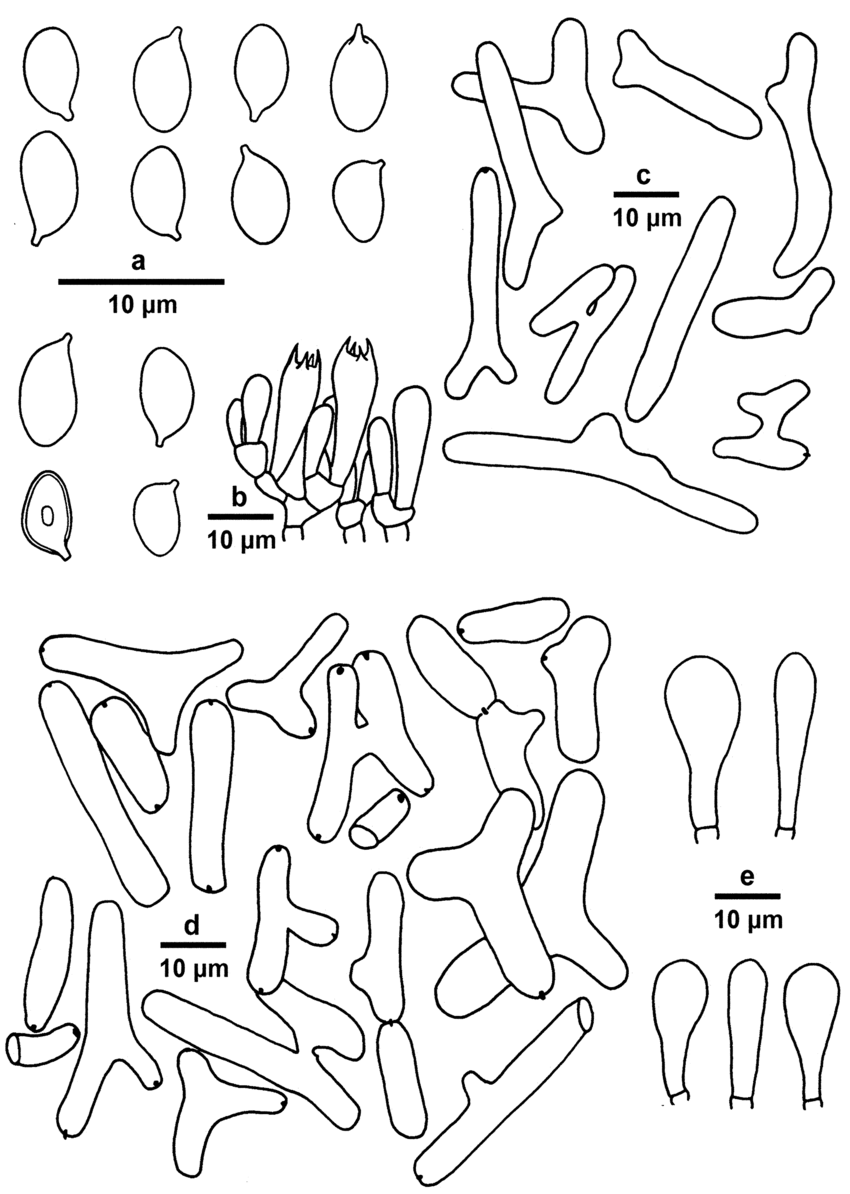
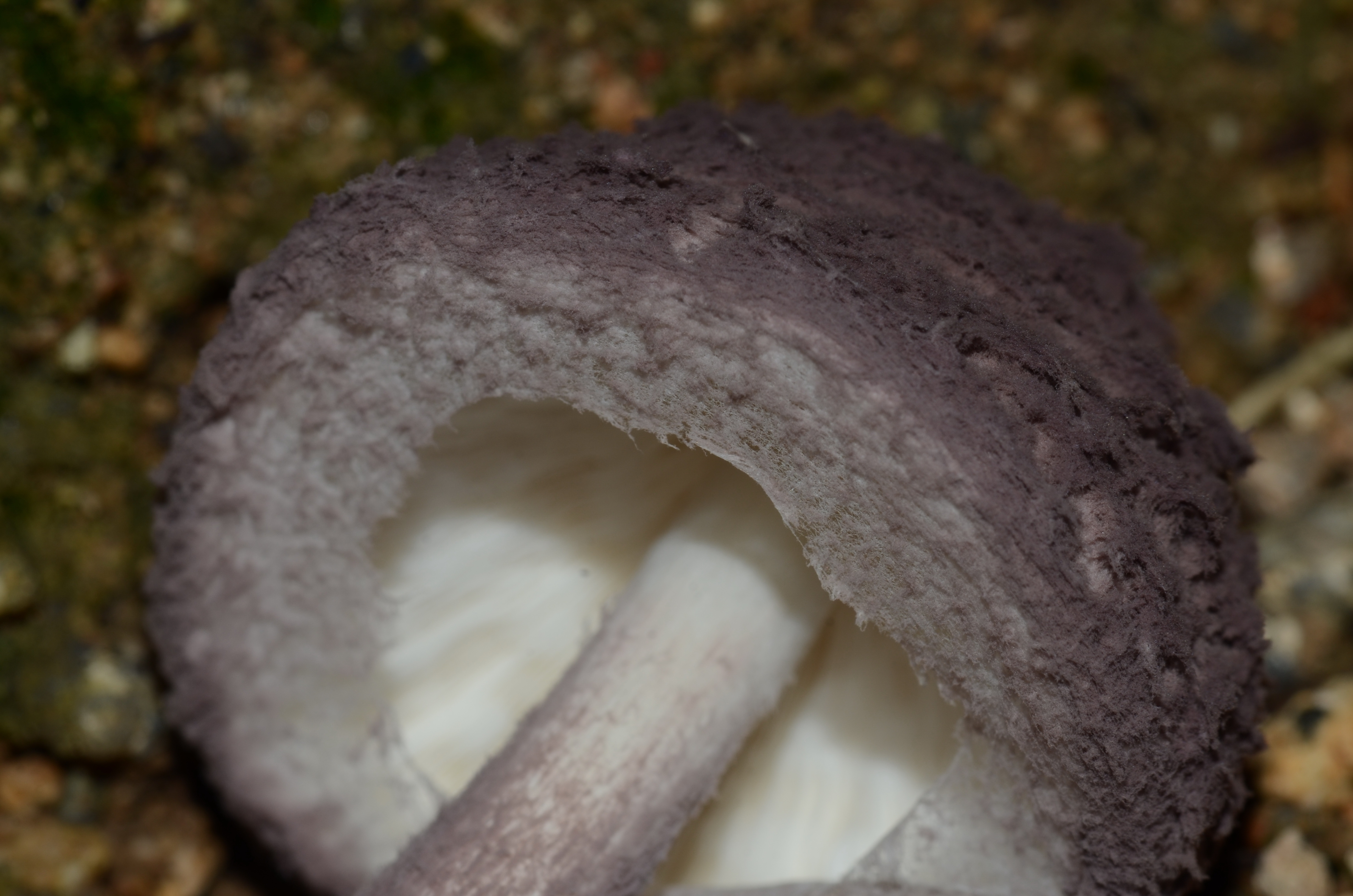
Coniolepiota spongodes (Berk. & Broome) Vellinga, Mycologia 103: 502, 2011. Figs 2, 3
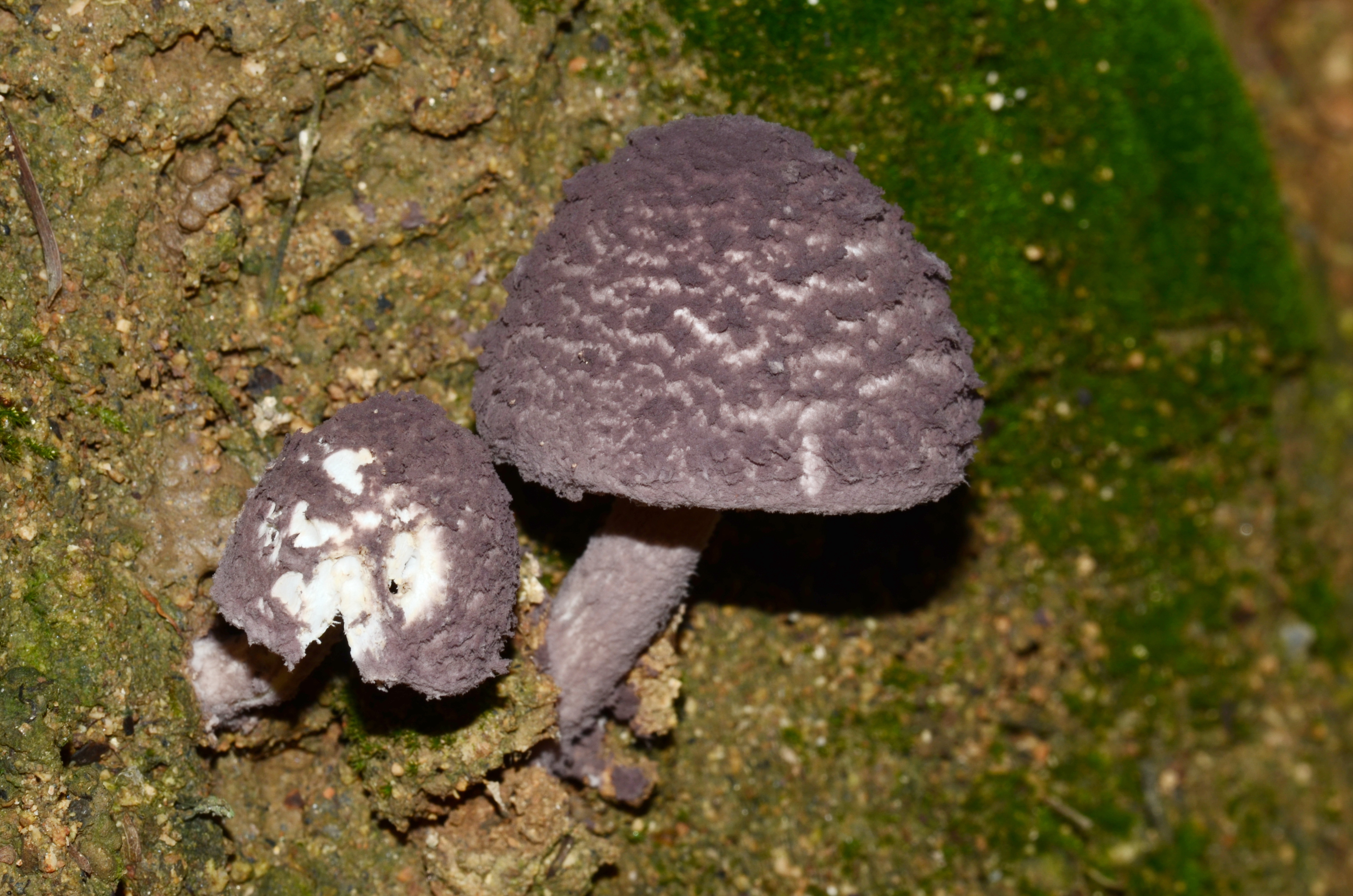
Basidiomata solitary, medium-sized. Pileus 40–80 mm broad, planoconvex to applanate with slightly inflexed margin, covered with lilac to purplegray powdery velar warts at young stage which remain in some areas especially in the center, but in outer zone sometimes disappearing, showing the pallid to whitish background; warts thick at center, becoming spread out towards margin, sometimes with powdery warts hanging over the margin. Lamellae 14 × 4 mm, free and remote from the stipe, crowded with lamellulae, pallid cream to pale yellowish. Stipe 25–50 × 6–10 mm, central, cylindrical, usually slightly tapering upward, glabrous and pallid white at apex but the remaining parts covered with powdery lilac warts as on pileus, base slightly swollen and covered with whitish mycelium, hollow. Annulus present, thin membranous and easily detachable. Context 7 mm thick at the center of the pileus, dull white to slightly pale purplish.
Basidiospores [80/4/4] 4–5(–6) × (2.8–)3–3.2(–3.5) µm [Q = 1.43–1.57, Qm = 1.52 ± 0.127], ellipsoid to somewhat oblong, hyaline to pale yellowish, dextrinoid, inamyloid, nearly rounded apex, smooth, slightly thick-walled, without germ pore. Basidia 12–20 × 5–7 µm, cylindro-clavate to clavate, hyaline to pale yellowish in H2O, thin-walled, tetrasporic but occasionally 2- or 3-spored. Cheilocystidia 20–26 × 6–9 µm, clavate to clavulate, some cylindroclavate, hyaline, thin-walled, smooth, without encrustations, not abundant, scattered and sometimes hard to find. Pleurocystidia not observed. Pileus covering a powdery layer made up of irregularly shaped cylindrical cells, three dimensional (T-shaped), some anastomosing (H-shaped), individual elements 20–50 × 4–10 µm, hyaline, smooth, without incrusting pigments, refractive connecting points often present at the septate portion or near to the ending points of the pileal hyphae. Stipe covering similar to those of pileus but refractive connecting points is less common. Clamp connections absent in all tissues.
Habit & Distribution — Solitary or in small groups of two along roadsides in forests of S. robusta, in Bangladesh. Known also from Sri Lanka, Thailand, Singapore, Malaysia, tropical China.
Specimens examined — BANGLADESH. Rangpur Division: Thakurgaon, Pirganj, Thumnia Sal Baghan, 70 m a.s.l., 18 July 2011, M.I. Hosen 239a (HKAS 77574; GenBank KC625530, KC625531); 18 June 2012, M.I. Hosen 373 (HKAS 77575); Dinajpur, Birganj, Singra Forest, 60 m a.s.l., 1 July 2013, M.I. Hosen 708 (SHAF 5); Dhaka Division: Tangail, Madhupur, Madupur National Park, 20 m a.s.l, 3 August 2012, M.I. Hosen 561 (HKAS 77576). CHINA. Yunnan Province: Luxi, Santai Mountain, 1200 m a.s.l., 29 July 1979, Zheng Wen Kang 79078 (HKAS 4848); Menhai, Mangao Nature Reserve, 1250 m a.s.l., 16 August 1991, Zhu L. Yang 1590 (HKAS 24071); Ruili, Nongdao, 1130m a.s.l., 31 July 2003, Luo Hong 92 (HKAS 43631); Hainan Province: Wuzhishan, Wuzhishan Nature Reserve, 1867 m a.s.l., 1 August 2010, Z.W. Ge 2570 (HKAS 60246; GenBank KC871015).
Comments — Coniolepiota spongodes is restricted to southeast and south Asia. It is an attractive species for mushroom pickers as it can be readily recognized by the purplish to gray lilac coverings of the pileus and stipe surface. Distinguishing microscopic characters include the absence of abundant cheilocystidia, small smooth ellipsoid to oblong basidiospores, cylindrical elements in the pileal and stipe coverings, and absence of clamp connections in all tissues. Vellinga, who established Coniolepiota as an independent genus in Agaricaceae based on morphological and molecular evidence, presented the full synonymy of C. spongodes (Vellinga et al. 2011). According to Pegler (1972, 1986) basidiospores of C. spongodes are dextrinoid, which was confirmed by our study. The Chinese materials of C. spongodes also bear the same features that were observed in Bangladesh specimens: pileus and stipe coverings gray purple, basidiospores measuring [4/4/80] 4–5.5 × (2.5–)3–3.5(–4.0) µm [Q = 1.41–1.67, Qm = 1.52 ± 0.118], ellipsoid, colorless, dextrinoid, inamyloid, slightly thick-walled, and without germ pore. Vellinga et al. (2011) reported that the basidiospores from Thai collections are pale or barely weakly dextrinoid in Melzer’s reagent. Phylogenetically, C. spongodes nests within the Agaricus s.l. clade based on multi-gene analysis with four different loci (ITS, nrLSU, tef1-α, and rpb2; Vellinga et al. 2011). Coniolepiota spongodes is closely related to the coloredspored genera Agaricus L., Heinemannomyces Watling, and Clarkeinda Kuntze (Vellinga et al. 2011). In our molecular analysis H. splendidissima Watling is strongly supported to be sister group to Coniolepiota with ML (96%) and BI (1.0) values, followed by Agaricaceae sp., Eriocybe chionea Vellinga and Clarkeinda trachodes (Berk.) Singer (Fig. 1). Vellinga et al. (2011) described the genus Coniolepiota to include collections of C. spongodes from Malaysia, Singapore, and Thailand. A collection from Thailand (ECV 3613), described as having pink-tinges to the pileus and stipe, was designated as C. aff. spongodes but not formally named. Minor differences in cheilocystidia shape and color of basidiomata were possibly due to environmental variation. Inclusion of our Bangladesh and Chinese collections in phylogenetic analysis of ITS-nrLSU support the recognition of a single species in the genus rather than two distinct, sister species.
粉尘环柄菇 图18
Coniolepiota spongodes (Berk&Broome) Vellinga, Mycologia 103: 502, fig. 4/A-B, 6,2011.
Agaricus spongodes Berk & Broome, Journ. Linn. Soc., Bot. 11: 506, 1871.
Lepiota spongodes (Berk.&Broome) Sacc., Syll.Fung.5:62,1887.
Agaricus euconiatus Berk & Broome, Journ. Linn. Soc., Bot. 11: 508, 1871.
Lepiota euconiata (Berk.& Broome) Sacc.,Syll.Fung.5:62,1887.
担子果中等至大型,偶小型。菌盖直径 5~12cm,半球形至扁平,白色至污白色,淡紫灰色粉尘状至绒状鳞片,有时鳞片褪为白色,中央具钝凸,被淡紫灰色粉末状至绒状鳞片;菌盖边缘常内卷,有紫灰色粉末状至絮状物;菌肉白色,不变色,松软、海状,中部厚达1cm。菌褶离生,白色,老后灰白色。菌柄长 5~14 cm, 直径 0.5~2 cm近圆柱状,白色至污白色,常被淡紫罗兰色粉末状至絮状物,中空,基部常膨大。菌环膜质,上部生,近白色,边缘具紫灰色粉末状至绒状鳞片。孢子印白色至灰白色。
担子 14~18 x 5~7 μm,棒状,具 4 孢梗。担孢子 4~5.5 x(2.5)3~3.5(4)μm[Q=(1.30)1.41~1.67,
Q=1.52±0.09],侧面观椭圆形,偶近杏仁形,上脐部不凹陷,无色,透明,光滑,壁略厚,稍类糊精质。侧生囊状体阙如,褶缘未见囊状体。菌盖表面鳞片由不规则至毛状排列、直径 4~10 μm、具多横隔的菌丝组成,菌丝细胞很易在横隔处断裂脱落而呈杆状,细胞中常含有紫灰色胞内色素;末端细胞近圆柱形至窄棒状(25~50x4~10 μm)。锁状联合阙如。
生境:夏秋季生于热带地区林中地上。
世界分布:亚洲热带地区(马来西亚、孟加拉国、斯里兰卡、泰国和新加坡)。在我国见于南部热带地区。
模式产地:斯里兰卡。
研究标本:海南:五指山市,五指山,海拔1870m,2010年8月1日,葛再伟2570(HKAS 60246)。云南:勐海,曼搞自然保护区,海拔1250m,1991年8月16日,杨祝良1590(HKAS 24071);勐腊,勐仑,中国科学院西双版纳热带植物园,海拔580m,1989 年10月21 日,杨祝良 766(HKAS 22518);同地,1990年8月19日,杨祝良1102(HKAS 23313);勐腊,勐仑,中国科学院西双版纳热带植物园,海拔580m,1989年10月21 日,杨祝良 766(HKAS22518);同地,2014年7月5日,刘晓斌372(HKAS87019);瑞丽,弄岛,海拔1130m,2003年7月31日,罗宏92(HKAS43631);潞西三台山,海拔 1200m,1979 年7月 29 日,郑文康79078(HKAS 4848);盈江,那帮,海拔 360 m,2003年7月11 日,杨祝良3619(HKAS 42678)。
讨论:粉尘环柄菇 Cn. spongodes 的主要特点是担子果中等至大型,菌盖白色至污白色,被淡紫灰色粉末状至绒状鳞片,菌盖边缘有紫灰色粉末状至絮状物,菌肉松软、海绵状,担孢子椭圆形(4~5.5x3~3.5 um),菌盖表面鳞片由不规则至近规则排列、直径4~10um、具多横隔的菌丝组成,菌丝细胞很易在横隔处断开而脱落呈杆状,无锁状联合(Hosen &Yang,2013)。
Pegler(1972,1986)曾将粉尘环柄菇置于环柄菇属卵孢环柄菇组 sect.Ovisporae中,但其菌表鳞片粉末状至绒状、鳞片由具多隔在横隔处易断脱的菌丝组成,这在环柄菇类真菌中是不存在的。Vellinga 等(2011)根据形态和分子系统发育证据,将其独立为一个属。本卷采纳后者的观点。