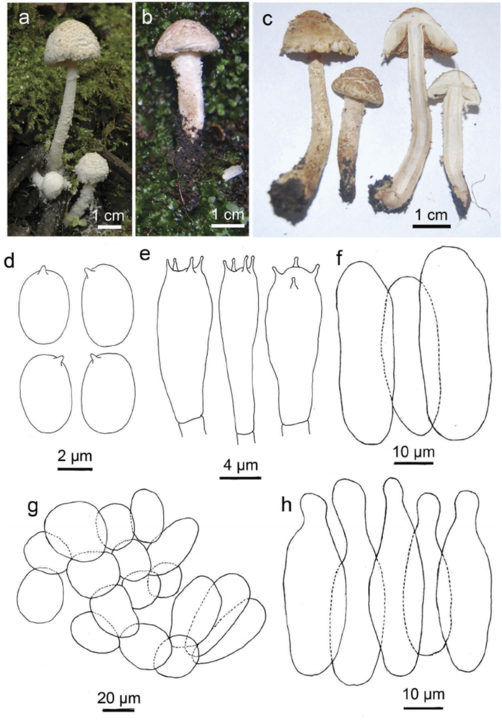
假瓶囊囊小伞 图21
Cystolepiota pseudofumosifolia M.L. Xu & R.L. Zhao, Mycology 7: 167,fig.2,2016
担子果很小。菌盖直径 1.5~2.2 cm,宽锥状至近半球形;表面白色至污白色,密被絮状至粉末状鳞片;鳞片幼时白色,后变为淡褐色至褐色;菌肉白色。菌褶离生,较密,不等长,米色,干后不变为褐色或灰褐色。菌柄长 3~7cm,直径 0.4~0.8cm,近圆柱形,向上稍变细,菌环之上近光滑,白色,菌环之下密被与菌盖表面同色的絮状至粉末状的鳞片,中空。菌环上位至近顶生,薄,膜质,易消失。
菌褶菌髓为规则型,由直径 5~10 μm 的菌丝构成。担子 14~18x4.5~5μm,棒状,具4孢梗,有时具2孢梗,孢梗长 2~3μm;担子基部横隔上有锁状联合。担孢子4~5x2~2.5(3)μm[Q=(1.60)1.79~2.05 (2.25),
Q=1.88±0.18],长方椭圆形,基部常稍宽,无色,非淀粉质,非类糊精质,光滑,薄壁;小尖细小。侧生囊状体 25~40x8~10 μm,在褶缘附近较多,在其他地方较少或阙如,棒状至近梭形,近无色透明或有黄色内含物。褶缘囊状体密集,花瓶状至腹鼓状(25~35x7~10 μm),近无色透明或有黄色内含物;顶端常呈头状。菌盖表面鳞片由不规则排列的菌丝和膨大细胞组成膨大细胞非常丰富,近球形、卵形至宽椭圆形(30~50x25~40μm),2~4个连成念珠状,近无色透明,薄壁;菌丝较丰富,直径 2~5μm,无色透明。担子果各部位皆有锁状联合。
生境:夏季生于林中地上。世界分布:亚洲(中国)。
模式产地:中国(云南)。
研究标本:云南,师宗,英武山,2011 年6月29 日,赵瑞琳 ZRL2011054(HMAS276122,模式);南涧,无量山,2012年7月3日,赵瑞琳ZRL2012038(HMAS 276123)。
讨论:假瓶囊囊小伞 C.pseudofumosifolia 的主要特点是担子果小型;侧生囊状体在褶缘附近较多,在其他地方较少或阙如,棒状至近梭形;褶缘囊状体密集,花瓶状至腹鼓状,顶端常呈头状。
该种酷似瓶囊囊小伞 C.fumosifolia (Xu et al.,2016),但后者菌褶干后变为褐色至灰褐色,侧生囊状体和褶缘囊状体花瓶状至蛇形。由于本卷作者研究的假瓶囊囊小伞标本有限,加之上述引证标本在 5%的 KOH 溶液中不能较好恢复,其形态特征描述尚需今后在获得更好的标本后补充和完善。
Cystolepiota pseudofumosifolia M.L. Xu & R.L. Zhao,sp. nov. (Figure 2).Fungal names: FN570270
Etymology: refers to the similarity to the species C.fumosifolia (Murrill) Vellinga in morphology.
Pileus 15–22 mm in diameter, hemispherical, andwith densely floccose-verrucose covering whenyoung, later expanding to conic, wide conic, surfaceheavily granulose to powdery, and often formingthick squamose, somewhat cracked, pitch-like, lightbrown (oac765), brown (oac647) on a whitish back-ground when old, margin straight. Context firm,white, 2- to 3-mm thick at disc. Lamellae free, lamellulae in three series, close to crowded, ventri-cose, 4-mm broad, white, edges smooth. Stipe30–70 × 4–8 mm, cylindrical or long clavate, hollow,surface light yellowish brown, brown, heavily squa-mose, warted, or powdery. Annulus membranous,smooth at the upper side and floccose at lowerside, white, broken. No discolouring on touching orbruising.
Basidiospores 4.2–5.2 × 1.9–2.5 μm,avl × avw = 4.9 × 2.2 μm, Q = 1.8–2.6, avQ = 2.2,ellipsoid to oblong, rarely cylindrical, smooth, hya-line. Basidia 19–21 × 4.2–6.5 μm, four-spored, smooth, and clavate. Cheilocystidia numerous, ven-tricose-capitate, hyaline, the width reaching 18 μm,and the length reaching 40 μm. Pleurocystidia notobserved. Marginal cells separated with each other,43–52 × 9–18 μm, smooth, yellow, and cylindricalwithout ventricose-capitate. Pileipellis epithelium,composed of loosely globose and elliposoid cells inchains, 34–60 × 24–40 μm, and contains yellow pig-ments. Clamp connect present.
Habit: solitary or scattered in deciduous woods onnutrient-rich soil.
Material examined: China, Yunnan Prov., ShizongCounty, Yingwu Mountain, 29 June 2011, CollectorRuilin Zhao, ZRL2011054 (HMAS276122, Holotype);Yunnan Prov., Nanjian County, Wuliang MountainNational Natural Reserve, 3 July 2012, CollectorRuilin Zhao, ZRL2012038 (HMAS 276123).
Discussion
Vellinga provided an in-depth and comprehensivedescription of Cystolepiota, including a key toCystolepiota species (Vellinga 2001,2007).Cystolepiota bucknallii (Berk. & Broome) Singer &Clémençon and Cystolepiota icterina F.H. Møller exKnudsen have lilac-tinged pileus; the cap ofCystolepiota moelleri Knudsen is covered with smallpink granulose warts, and C. seminuda (Lasch) Bon hasa vinaceous stipe, characters which make them easilydifferentiated from C. pseudofumosifolia in the field.Cystolepiota petasiformis (Murrill) Vellinga andCystolepiota pulverulenta (Huijsman) Vellinga are dis-tinct species in this genus because they have elongateand inflated pileipellis cells, which is also an obviousfeature to separate it from the new species.
Cystolepiota oregonensis (H.V. Sm.) Vellinga is similarto the new species in the field, but the former showsreddish-brown discoloration after touching orbruising.
The phylogenetic tree of Cystolepiota indicatedthat our samples belong to Cystolepiota and repre-sented a different species from C. bucknallii,Cystolepiota adulterina (F.H. Møller) Bon, C. seminuda,C. hetieri, and C. pulverulenta (Huijsman) Vellinga(Figure 1). Furthermore, these two specimens belongto the same species and are closely related to C.fumosifolia (Murrill) Vellinga. C.pseudofumosifolia isalso morphologically similar to C. fumosifolia becausethey share not only macroscopic characters but alsomicroscopic characters, such as size and shape of thepileipellis and cheilocystidia (Vellinga 2006).However, our species presents smaller and narrowerspores than those of C. fumosifolia (4.9–5.7 × 2.6–3.1 μm, avQ = 1.8). A key to known species ofCystolepiota in China is provided.