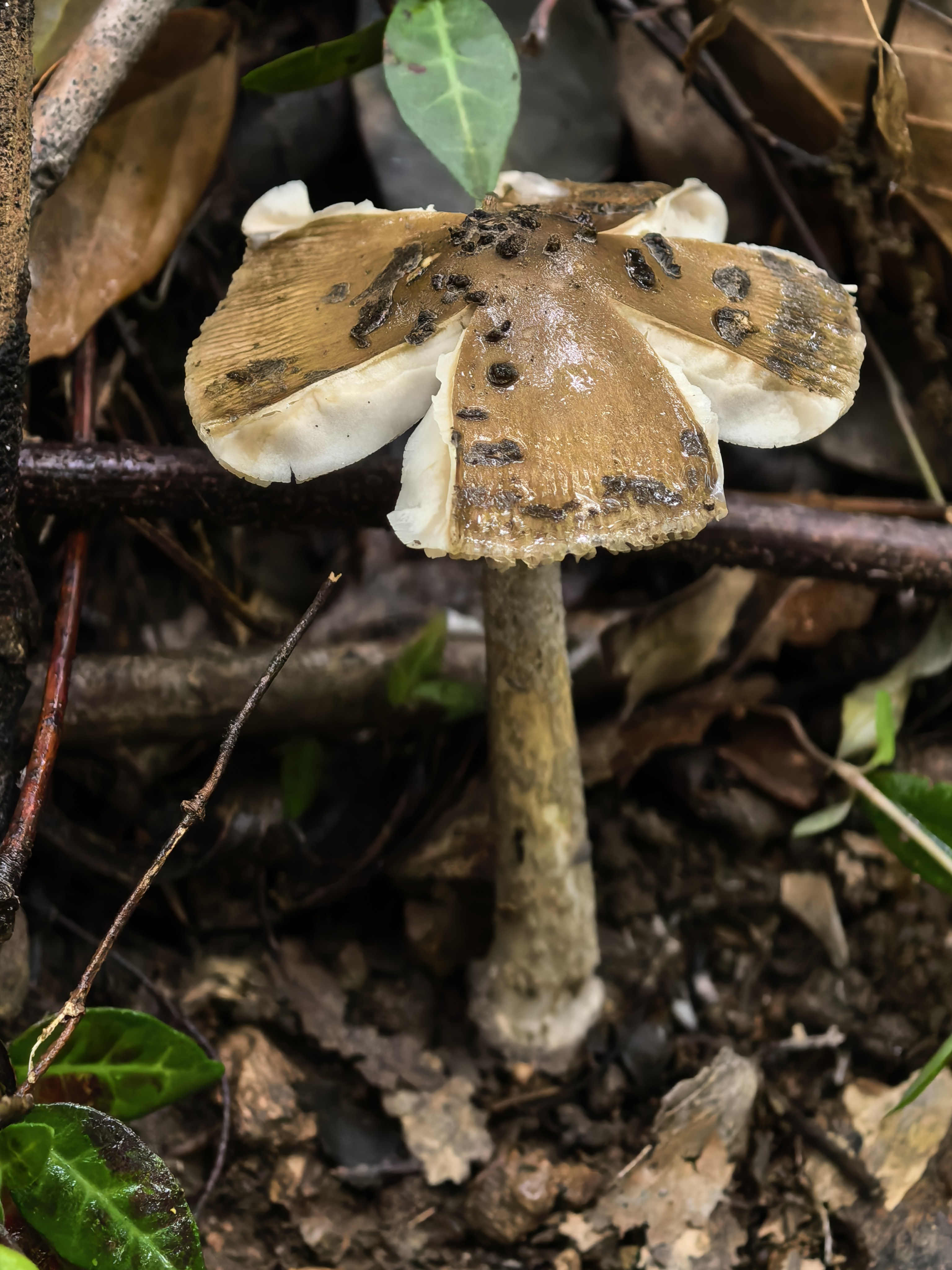
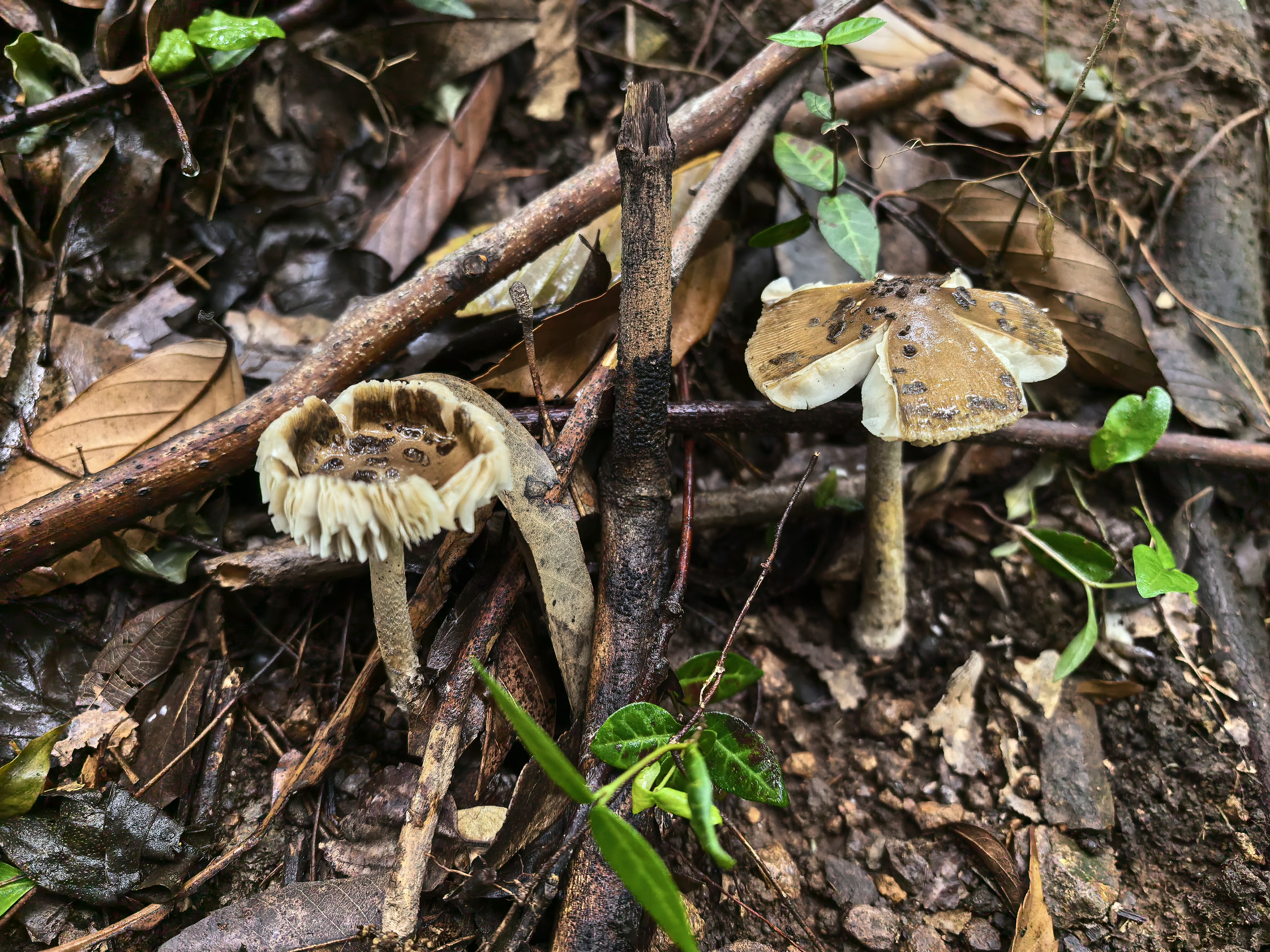
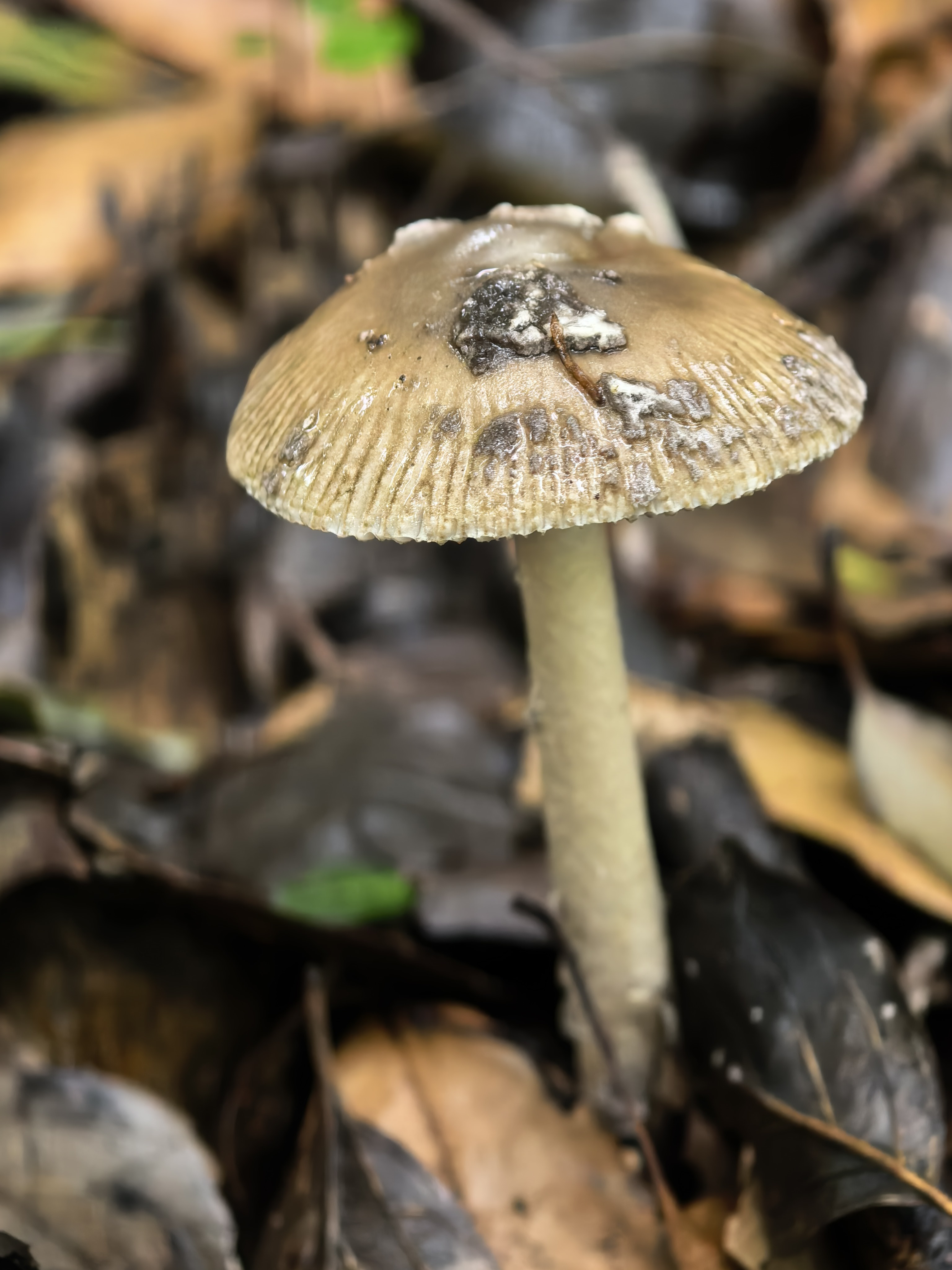
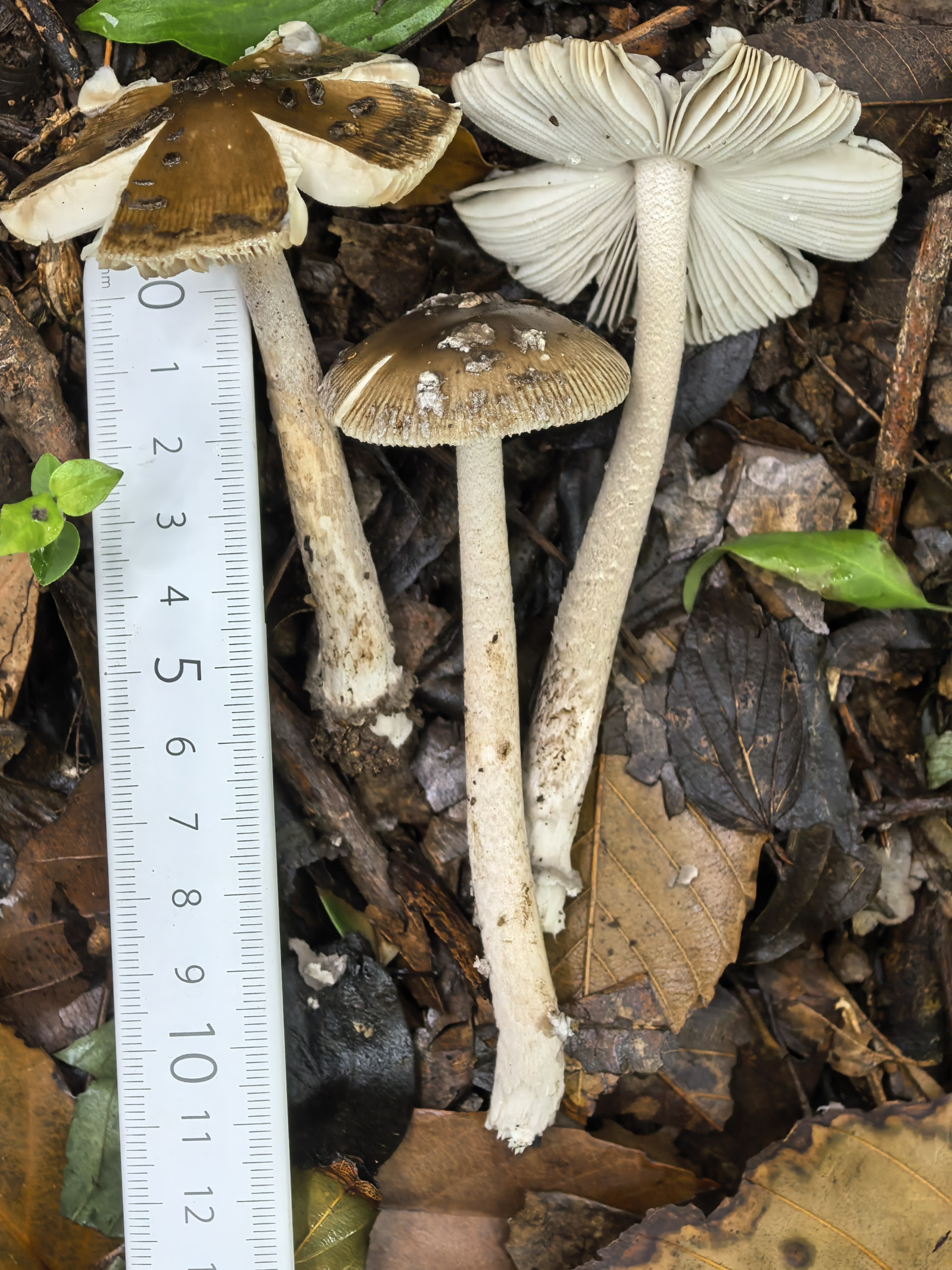
Amanita griseofolia Zhu L . Yang , sp . nov . Fig1-7
Amanita ceciliae sensu Zhu L . Yang , Biblioth . Mycol .170:116,1997, p . p .
Pileus 3-7(10.5) cm diametro , convexus vel applanatus , obscure umbonatus vel non - umbonatus , griseo - brun - neus vel brunneo - griseus , non luteus , non flavus , non ochraceus , margine sulcata (0.2-0.4R), non appendiculata , eliuiis volvae coactis , flocculosis vel verrucosis , griseis vel atrogriseis ornatus . Lamellae liberae , griseolae vel griseae , confertae ; lamellulae truncatae . Stipes (6)8-17x0.5-1.5 cm , subcylindricus vel sursum attenuatus , haud bulbosus , albidus , cavus , squamellis griseis , fibrilloseis vel farinoseis , exannulatus , volvatus . Volva grisea vel atrogrisea , verrucolosa . Caro albida . Basidia 4- sporigera . Basidiosporae (9.5)10.0-13.5(16.5) x (8.5)9.5-13.0(15.0) um , globosae vel subglobosae , non amyloideae . Fibulae absentes .
Holotype : China , Yunnan , Kunming , Heilongtan ,1980 m asl ., on soil in forest dominated by Quercus sp ., Pinus armandi , and P . yunnanensis ,27.6.2001, Z . L . Yang 3081( HKAS 38159).
Etymology : griseofolia - referring to the greyish to grey lamellae.
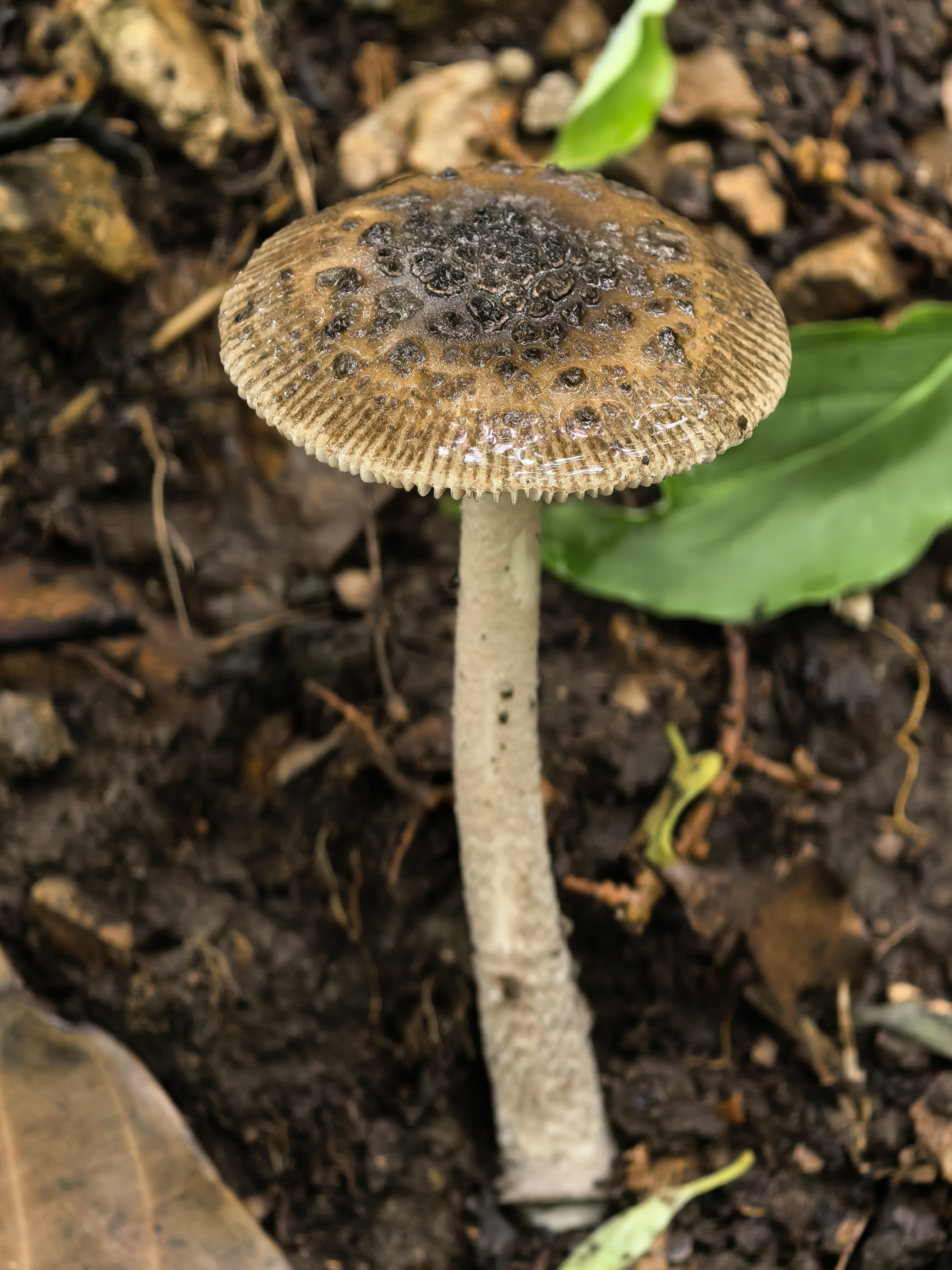
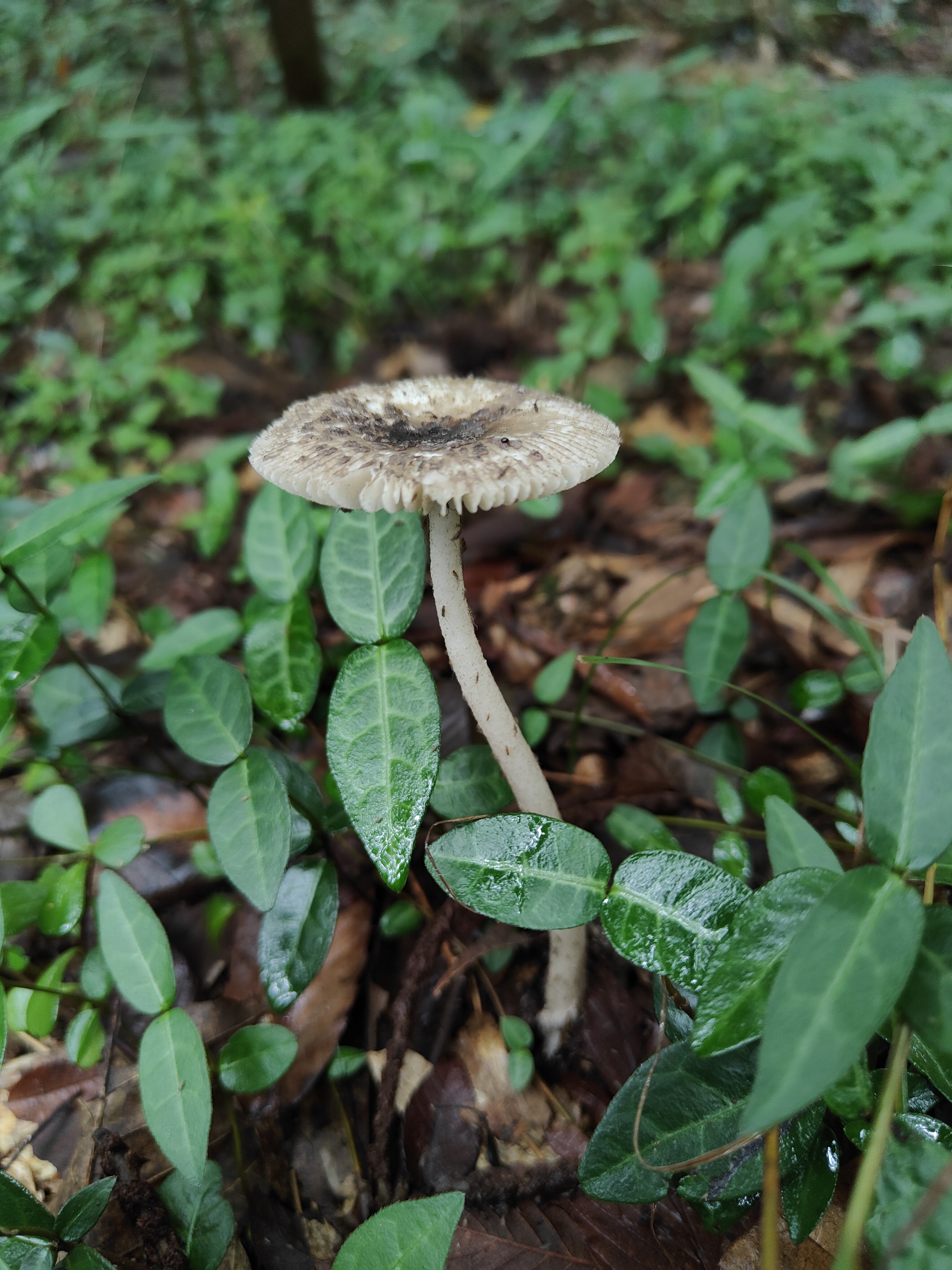
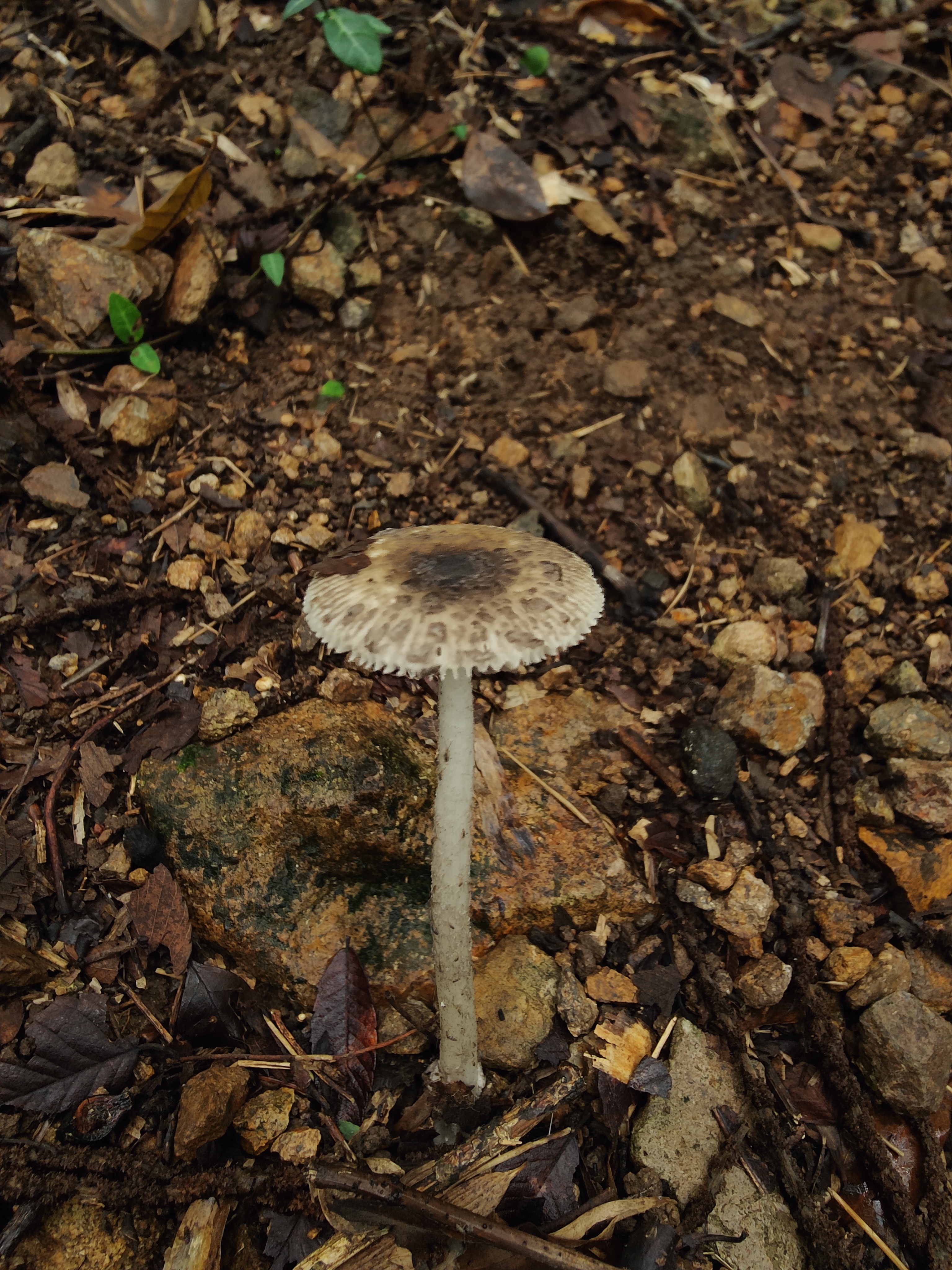
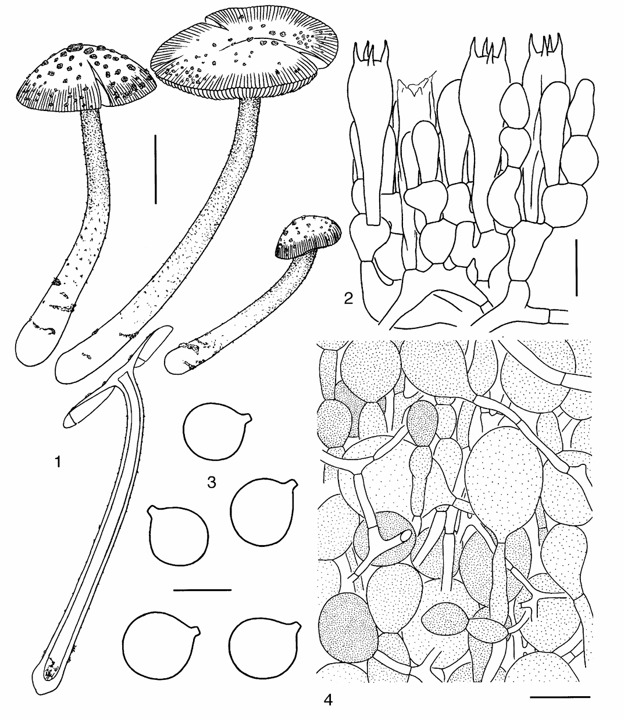
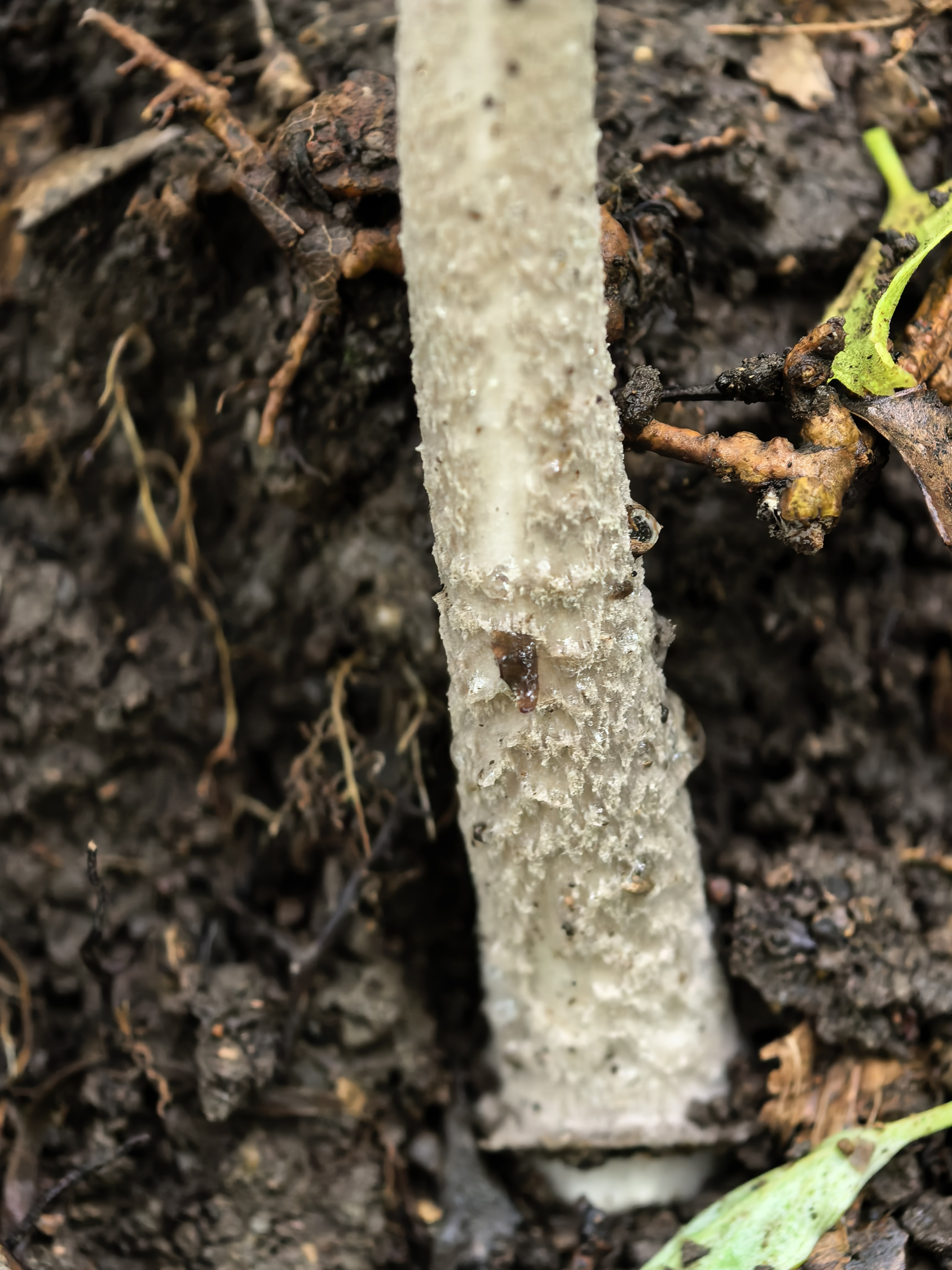
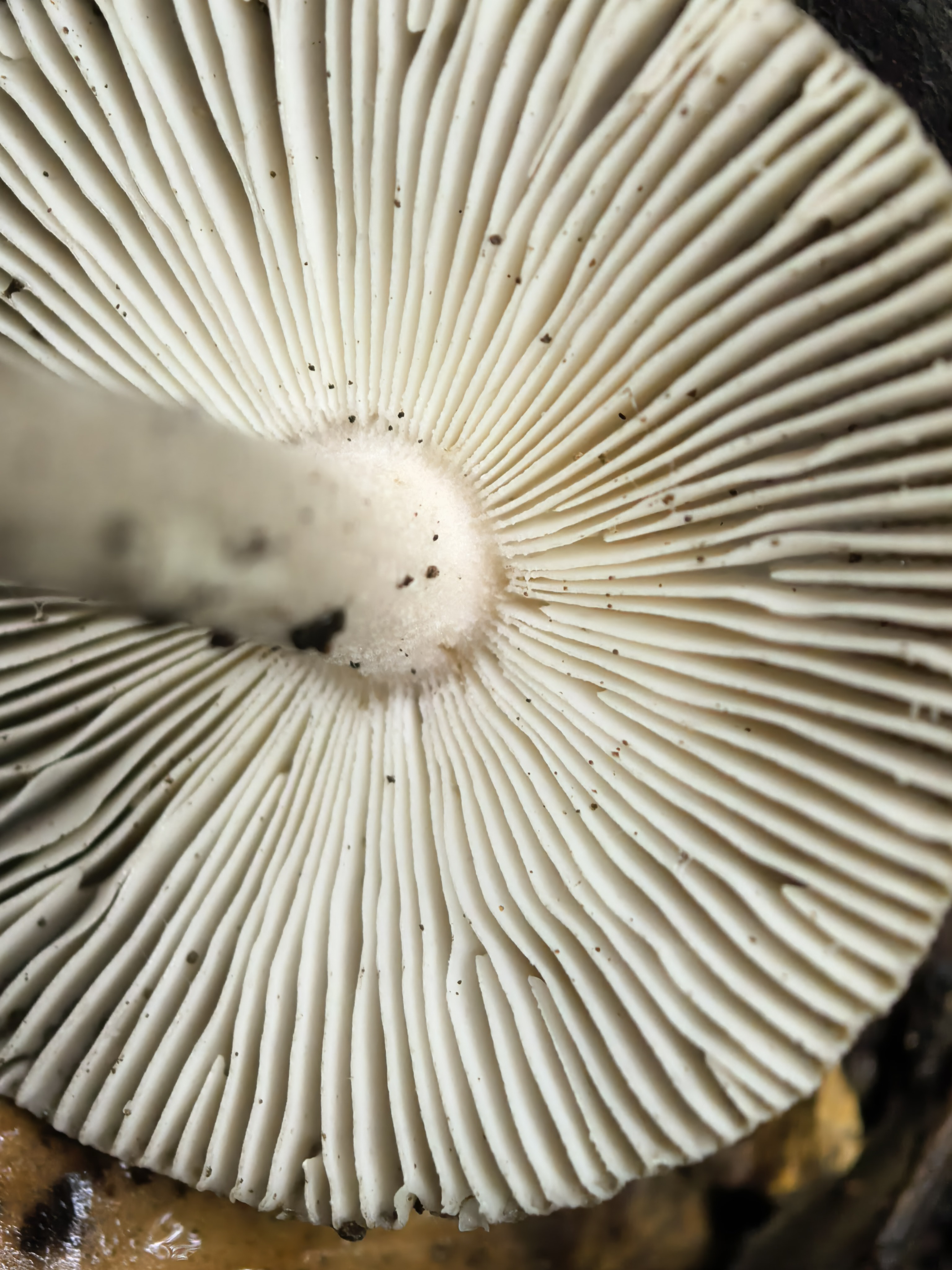
Basidiocarps ( Figs .1,5-7) small to medium - sized , rarely large . Pileus 3-7(10.5) cm diam , at first nearly campanulate to hemispherical , then convex to plano - convex , without an umbo or slightly um - bonate , brownish grey to grey - brown [ Natal Brown , Buffy Brown , Snuff Brown , Medal Bronze ,4B1-2,5C2-4,5D2-4,5E3-5], darker over disc , becoming somewhat paler towards the margin , lacking any yellow or ochreous tint at all stages of development ; margin tuberculate - striate (0.20-0.43R), non - appendiculate ; volval remnants grey to dark grey [ Iron Gray , somewhat darker than Smoke Gray ,4C1-2,4D1-2,4E1-2], verrucous to felty or farinose , sometimes irregularly formed ,0.5-1.5 mm thick , easily washed away by rain ; trama thin ,2-5 mm thick , white to whitish , unchan - ging . Lamellae free , crowded , whitish [ Cream Color , IAI -2J, but soon becoming greyish to grey [ Pale Smoke Gray to Light Drab , paler than 5D2], often becoming somewhat darker when dried ; lamellar edges grey to dark grey [ Iron Gray , darker than Smoke Gray ,4E1-2,5E1-3]; lamellulae truncate to subtruncate , plentiful , evenly distributed . Stipe (6)8-17 x 0.5-1.5 cm , subcylindric or slightly tapering upward , with apex slightly expanded , white to dirty white , lower half covered with grey to greyish [ Pale Smoke Gray ,4D2] fibrillose squamules , upper half densely covered with grey farinose squamules , fistulous ; context white to dirty white , unchanging ; basal bulb lacking ; volval remnants felty to granular or verrucous , grey to dark grey [ Iron Gray , Smoky Gray , Drab ,4E1-2,SE1-3], arranged irregularly or sometimes in incomplete belts or rings at stipe base . Annulus lacking . Smell indistinct .
Lamellar trama ± bilateral. Mediostratum 30–40 μm wide, composed of fairly abundant, long ellipsoid to subfusiform inflated cells (70–90 × 15–20 μm) and abundant interwoven, often anastomosing, 3–7 μm wide filamentous hyphae; vascular hyphae rare. Lateral stratum composed of fairly abundant, long ellipsoid to subfusiform inflated cells (40–60 × 10–15 μm), diverging at an angle of ca. 30° to mediostratum; filamentous hyphae fairly abundant to abundant, 3–7 μm wide, frequently branching, interwoven, sometimes anastomosing; vascular hyphae rare, 3–9 μm wide. Subhymenium (Fig. 2) 30–50 μm thick, with 2–3(4) layers of subglobose to ovoid or shortly ellipsoid cells, 12–25 × 10–20 μm, occasionally mixed with hardly inflated cells. Basidia (Fig. 2) 40–70 × 15–20 μm, clavate, 4-spored; sterigmata 5–7 μm long; basal septa without clamps. Basidiospores (Fig. 3) [456/28/22] (9.5)10.0–13.5(16.5) × (8.5)9.5–13.0(15.0) μm [Q = 1.0–1.10(1.18), Q = 1.04 ± 0.03], globose to subglobose, rarely broadly ellipsoid, inamyloid, colorless, hyaline, thin-walled, smooth; apiculus ca. 1 μm long. Lamellar edge as sterile, gelatinized, yellow-brown strip up to 250 μm wide in side view, predominantly composed of ovoid to subglobose, sometimes sphaeropedunculate inflated cells (20–50 × 15–35 μm), single and terminal or in chains of 2–3, colorless and hyaline, or with yellowish brown vacuolar pigments; filamentous hyphae fairly abundant to scattered, 2–7 μm wide, colorless and hyaline, sometimes with brownish vacuolar pigments, irregularly arranged or running parallel to the lamellar edge, elements embedded in yellow-brown amorphous matrix gradually disappearing in KOH. Pileipellis 50–100 μm thick; upper layer (20–60 μm thick) strongly gelatinized, composed of ± radially and moderately compactly arranged, 1–4 μm wide, thin-walled, colorless or brownish vacuolar pigmented filamentous hyphae; lower layer (30–50 μm thick) composed of radially and compactly arranged, 3–8(15) μm wide filamentous hyphae with brownish yellow, vacuolar pigments; terminal cells present, 5–10 μm wide, hardly inflated; vascular hyphae rare. Volval remnants on pileus (Fig. 4) composed of ± vertically (over disc) to irregularly (on other parts of the pileus) arranged elements. Inflated cells very abundant to dominant, subglobose, ovoid to shortly ellipsoid (20–70 × 15–50 μm), sometimes broadly clavate (40–60 × 20–30 μm) or sphaeropedunculate (50–80 × 25–45 μm), often in chains of 2–3 and then terminal, thin- to slightly thick-walled (up to 0.5 μm thick), often with brownish yellow vacuolar pigments; filamentous hyphae scattered to fairly abundant, 2–7 μm wide, frequently branching , often anastomosing , thin - walled , colorless and hyaline , sometimes with brownish yellow vacuolar pigments ; vascular hyphae rare ,2-8 μm wide . Volval remnants on stipe base similar to those on the pileus , but inflated cells and filamentous hyphae irregularly arranged . Stipe trama composed primarily of longitudinally arranged , long clavate , terminal cells ,250-350x 25-40μm ; filamentous hyphae 2-7μm wide , scattered ( in interior ) or abundant ( on stipe surface ); vascular hyphae rare ,2-10 um wide . Clamps absent in fruitbody .
Specimens examined : CHINA , Beijing , Tanzhesi , on soil ,25.7.1958, S . C . Teng 6063( HMAS 22610); Beijing , Tanzhesi , on soil ,29.7.1959, W . X . Wang and X . L . Kong 74( HMAS 26499); Hainan , Changjiang , Bawangling ,1350 m asl ., on soil in broad - leaved forest ,24.8.1990, Q . Chen ( GDGM 16689); Hainan , Ledong , Jianfengling ,900 m asl ., on soil in broad - leaved forest ,25.9.1987, Z . S . Bi and T . H . Li ( GDGM 12414); Henan , Shiziping , on soil ,26.8.1968, H . Z . Li et al .162b( HMAS 35975b); Jilin , Antu , Changbaishan ,1750 m asl ., on soil ,5.8.1960, Y . C . Yang et al .564( HMAS 29135); Jilin , Antu , Changbaishan , no date , Z . X . Xie 820373( IFP ); Xizang ( Tibet ), Bomi , Galongla ,3000 m asl ., on soil in forest ,24.8.1982, X . L . Mao 227( HMAS 51439). Yunnan , Chuxiong , Zixishan ,2400 m asl ., on soil under trees of Lithocarpus sp . and Pinus armandi ,2.8.2001, Z . L . Yang 3144( HKAS 38321); Yunnan , Guangnan , Maojie ,1500 m asl .,27.6.1959, Q . Z . Wang 688( HMAS 26498); Yunnan , Kunming ,17.6.1973, Y . C . Zong et al .155( HMAS 36284); Yunnan , Kunming , on soil ,30.6.1973, Q . M . Ma et al .285 and Y . C . Zong et al .285( HMAS 36036 and 37441 respectively ); Yunnan , Kunming , Dapiji , on soil under trees of Quercus sp .,8.7.1942, W . F . Chiu 8216( HMAS 4216); Yunnan , Kunming , Heilongtan ,21.8.1987, Y . Xuan 1385( HKAS 18318); Yunnan , Kunming , Heilongtan ,1980 m asl ., on soil in foret dominated by Quercus sp ., Pinus armandi , and P . yunnanensis ,27.6.2001, Z . L . Yang 3081( HKAS 38159, HOLOTYPE ); Yunnan , Kunming , Heilongtan , on soil in forest with species of Quercus and Pinus ,30.6.1991, Z . L . Yang 1074( HKAS 24219); Yunnan , Kunming , Heilongtan ,1980 m asl ., on soil under trees of Picea sp .,4.9.1999, Z . L . Yang 2628( HKAS 34081); Yunnan , Kunming , Jindian ,1700 m asl ., on soil ,29.9.1995, Z . L . Yang 2199( HKAS 29630); Yunnan , Kunming , Jindian , on soil under Pinus sp .,4.8.1995, M . Wang 3( HKAS 32507); Yunnan , Songming , Liangyushan , on soil in forest ,17.9.1979, G . H . Feng 13( HKAS 4646); Yunnan , Yingjiang , Xima ,1700 m asl ., on soil under trees of Lithocarpus sp .,16.7.2003, Z . L . Yang 3708( HKAS 42894).
Notes : Amanita griseofolia , a member of Amanita subgenus Amanita section Vaginatae ( Fr .) Qu é l . in the sense of YANG (1997), is characterized by its small to medium - sized , slender fruitbody with grey to dark grey , felty to verrucose or farinose , easily removed volval remnants on a grey , dark grey to brownish grey pileus , greyish to grey lamellae , a slender greyish stipe , felty to granular or verru - cose , grey to dark grey volval remnants in incomplete belts around the non - bulbous stipe base , and globose to subglobose , inamyloid basidiospores .
HKAS 4646,18318,24219, and 32507, as well as HMAS 4216 and 36284 were regarded as A . ceciliae by YANG (1997). However , A . ceciliae ( Berk . et Broome ) Bas , originally described from Europe , differs from A . griseofolia by its much more robust fruitbody with a yellow - brown , reddish brown to grey - brown or olive - brown pileus covered with lighter colored ( greyish to brownish ) volval remnants , white lamellae with white edges , and a relatively thicker stipe . Furthermore , the volval rem - nants at the base of the stipe of A . ceciliae often form a ring - zone above a strangulate region and a floccose , nearly cupulate structure at the very base of the stipe ( PHILLIPS 1990, Breitenbach & Kr ä nzlin 1995), and there are more filamentous hyphae in the volval remnants of European A . ce - ciliae [ France , Jura , near Noga ,2.10.1992, C . Bas 9341( L )] than in A . griseofolia . The basidio - spores of A . ceciliae are slightly larger than those of A . griseofolia ( TULLOSS , OVREBO & HALLING 1992, BREITENBACH & KR ä nzlin 1995).
Amanita griseofolia is also similar to A . beckeri Huijsman ex Huijsman , A . cinctipes Corner et Bas , A . sororcula Tulloss , Ovrebo et Halling , and A . liquii Zhu L . Yang , M . Wei ß et Oberw . However , Amanita beckeri , originally described from Europe , differs from A . griseofolia by its differently colored pileus , white volval remnants browning in age , but never becoming grey or darker , white to crcam lamellae with brownish spots in age , and smaller basidiospores ( HUIJSMAN 1962a,1962b, TuLLoss 1994).
Amanita cinctipes , originally described from Singapore , is distinguished from A . griseofolia by its abundant volval remnants on the base of the stipe forming 2-4 rings , much thinner pileipellis , smaller basidia , and smaller basidiospores ( CORNER & BAS 1962).
Amanita sororcula , originally described from Colombia , South America , differs from A . griseo - folia by its smaller fruitbody , thinner pileipellis with common vascular hyphae , and somewhat smaller and less perfectly globose basidiospores ( TULLOSS , OvREBO & HALLING 1992).
Amanita liquii , originally described from southwestern China , differs from A . griseofolia by its larger , much more robust and fleshier fruitbody with a dark brown to blackish pileus covered with thicker and darker volval remnants , thicker pileipellis , somewhat larger basidia , and larger basidio - spores . Furthermore , the pigment in the cells of volval remnants of A . liquii is much darker than the similarly located pigment in A . griseofolia , and the volval remnants at the stipe base of A . liquii are more abundant than those of A . griseofolia ( YANG , WEISS & OBERWINKLER 2004).