Lepiota echinacea J.E. Lange, Flora Agaricina Danica 5: V (1940)
≡Cystolepiota echinacea (J.E. Lange) Knudsen, Botanisk Tidsskrift 73: 127. 1978.
≡Echinoderma echinaceum (J.E. Lange) Bon [as ‘echinacea’], Documents Mycologiques 21 (82): 63. 1991.
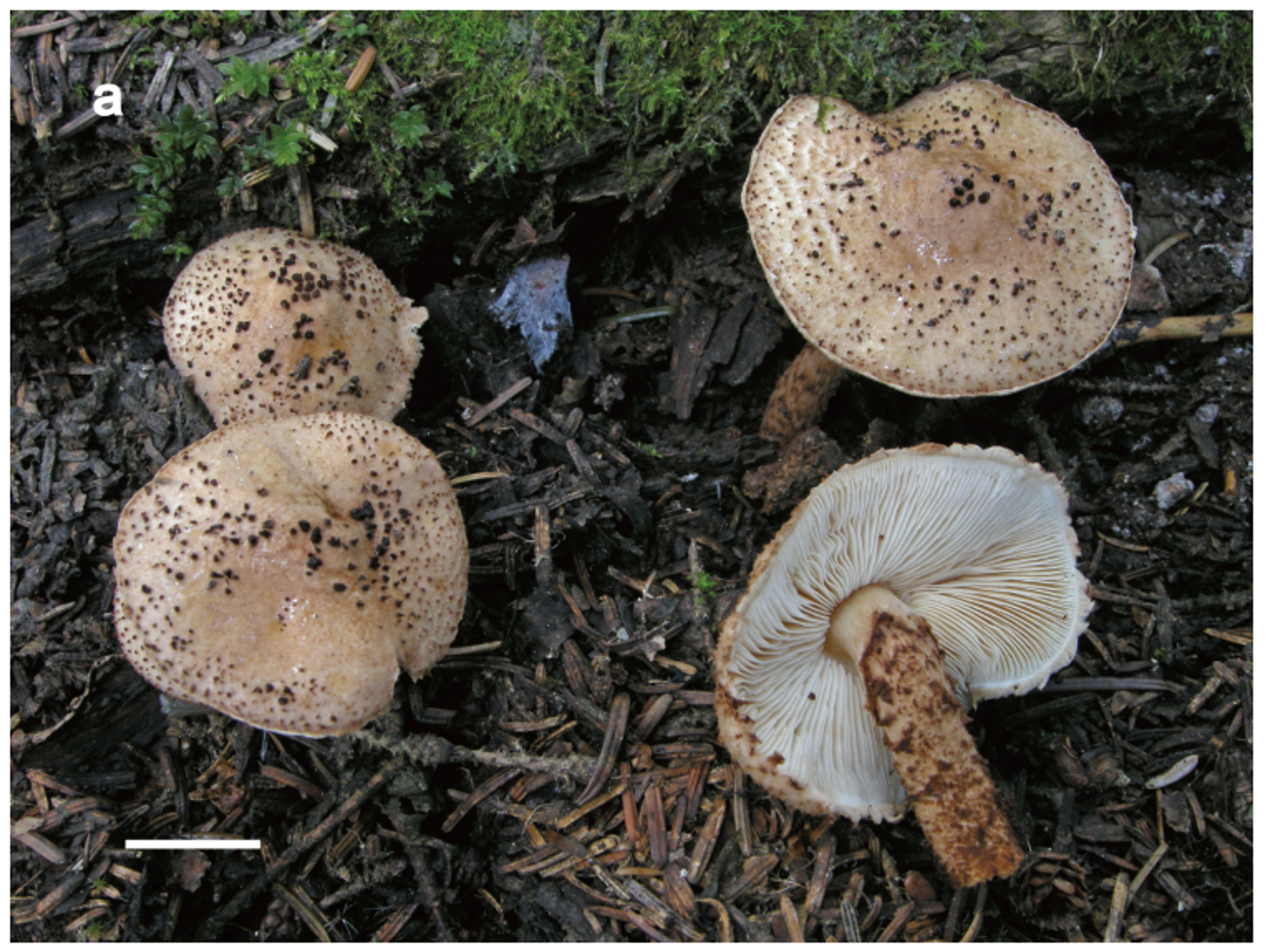
Description:—Basidiomata (FIG. 6a) small to medium. Pileus 20–56 mm, at first nearly hemispherical, then convex to plano-convex, finally expanded, dirty white (1B1) to fawn (1B4), covered with coarse, pyramidal, easily separable squamules, dark brown (1F8), sometimes with darker or blackish apex, squamules also present at margin, and tend to disappear starting from the center; context white. Lamellae moderately crowded, free, white (1A1) to cream-colored (2A2). Stipe 40–95 × 4–9 mm, subcylindrical or slightly tapering upward, with apex slightly expanded, dirty white (1B1) to fawn (1B4), at first a fluffy brown (4C8) veil connect it to the pileus, then detached and formed a net-like annular zone, above this zone nearly smooth, below this zone covered with fluffy brown squamules, veil at the base thicker. Lacking a distinctive odor.
Lamellar trama regular, consists of hyphae 3–12 μm in diam. Basidia (FIG. 7b) 12–22 × 6–8 μm, clavate, 4- spored; sterigmata 2–3 μm long; sometimes with clamps on basal septa. Basidiospores (FIG. 7a) [40/2/1] 5.0–6.0(–6.2) × 2.5–2.8(–3) μm, Q = 1.67–1.93(–2), Qm = 1.85 ± 0.14, ellipsoid to oblong, dextrinoid, colorless, thin-walled, smooth; apiculus small. Pleurocystidia absent. Cheilocystidia not observed. Squamules (FIG. 7c) composed of subsphaeroidal, cylindric, and globose cells (10–30 × 13–55 μm) arranged in chains, the elements with light dark brown intracellular pigments, thick-walled. Clamp-connections present.
Habitat and distribution:—Scattered in coniferous or mixed forests. Not previously reported from China. A rare but widespread species originally described from Denmark.
Specimen examined:—CHINA. Gansu Province: Gannan Tibetan Autonomous Prefecture, scattered and saprotrophic in spruce and birch forest, elevation 3082 m, 10 September 2018, S.P. Jian 257 (HKAS 105582!)
Comments:—Lepiota echinacea is an uncommon or rare yet widely distributed species and it is characterized by its dirty white to fawn pileus covered with dark brown acute squamules, dirty white stipe covered with fluffy brown squamules, larger basidiospores and the lack of cystidia. The macro- and microscopic characters of the collection from China match well with the original description of L. echinacea by Lange (1940). Bon (1991) placed this species in the genus Echinoderma based on the similar structure of the squamules. However, in our phylogeny this species is resolved in the genus Lepiota based on both molecular and morphological evidence. Our collection also represents a first record for China. This species is found in forests dominated by Picea purpurea, Abies fargesii and Betula sp. This species is closely related to L. asperula, L. jacobi, L. carinii and L. omninoflava, but morphologically different (refer to comments under Lepiota omninoflava).