Macrolepiota excelsa Vellinga, Sysouph., Thongkl. and K.D. Hyde sp. nov.
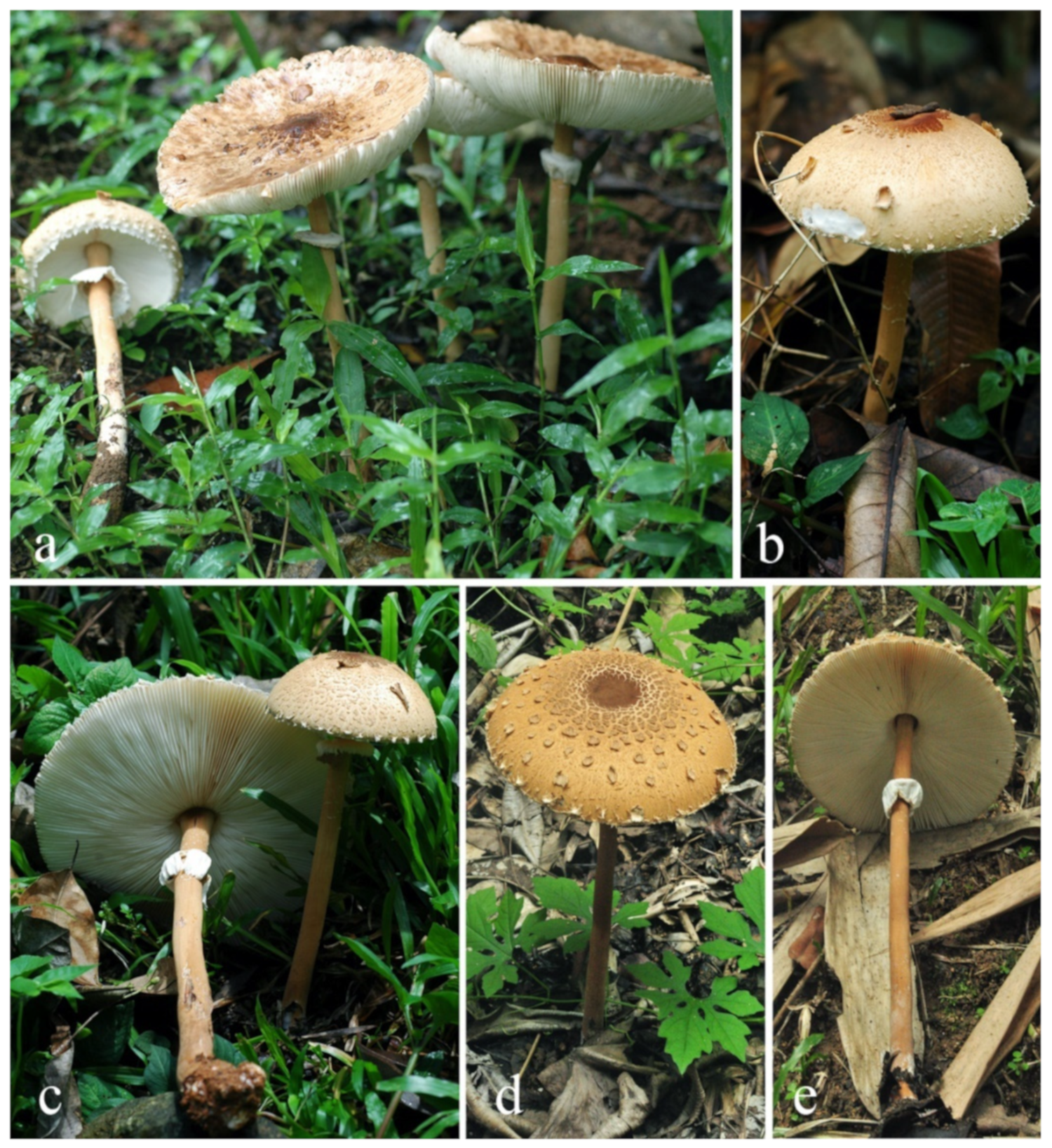
Mycobank umbero: MB 838685; Facesoffungi number: FoF 09700; Figure 19 and Figure 20.
Etymology: The Latin name ‘excelsa’ refers to ‘high, lofty, distinguished.’
Diagnosis: Macrolepiota excelsa is recognized by large brown to dark brown pileus, free and white lamellae, brown to dark brown cylindrical stipe with the white membranous annulus, broadly ellipsoid to ellipsoid basidiospore with a germ pore, utriform to narrowly clavate cheilocystidia, a hymeniderm made up of clavate to cylindrical elements in pileus covering.
Holotype: ecv3572 (UC).
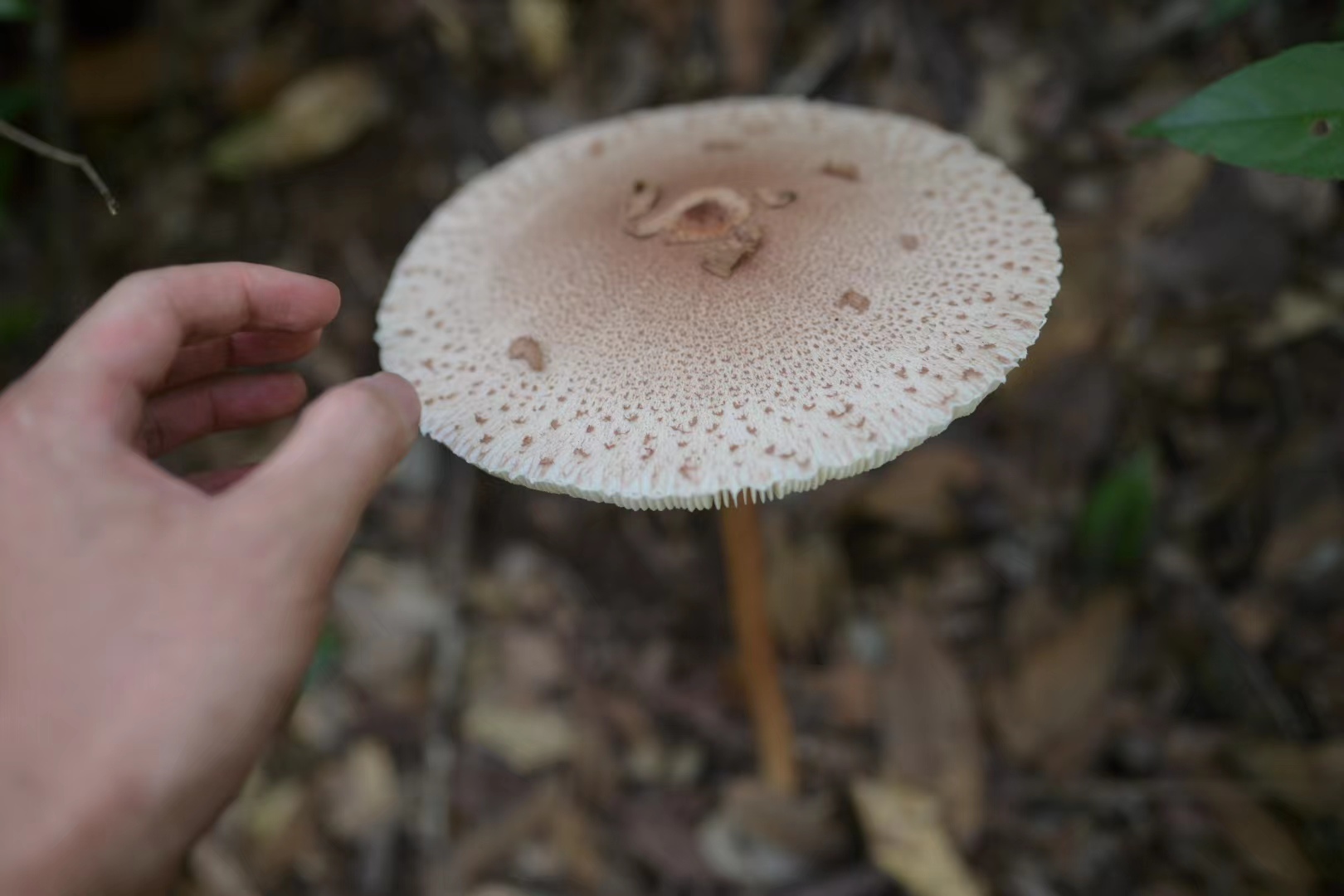
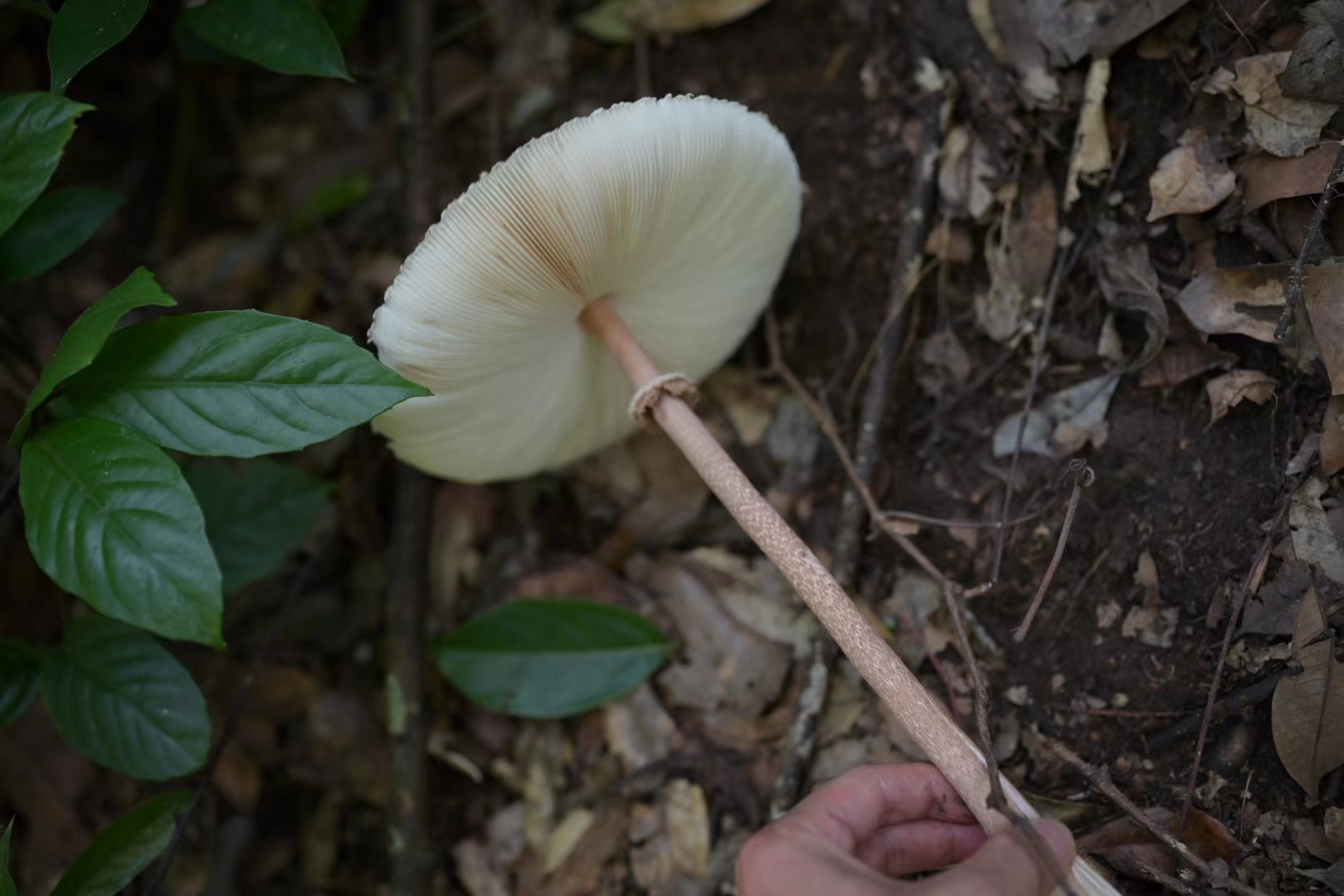
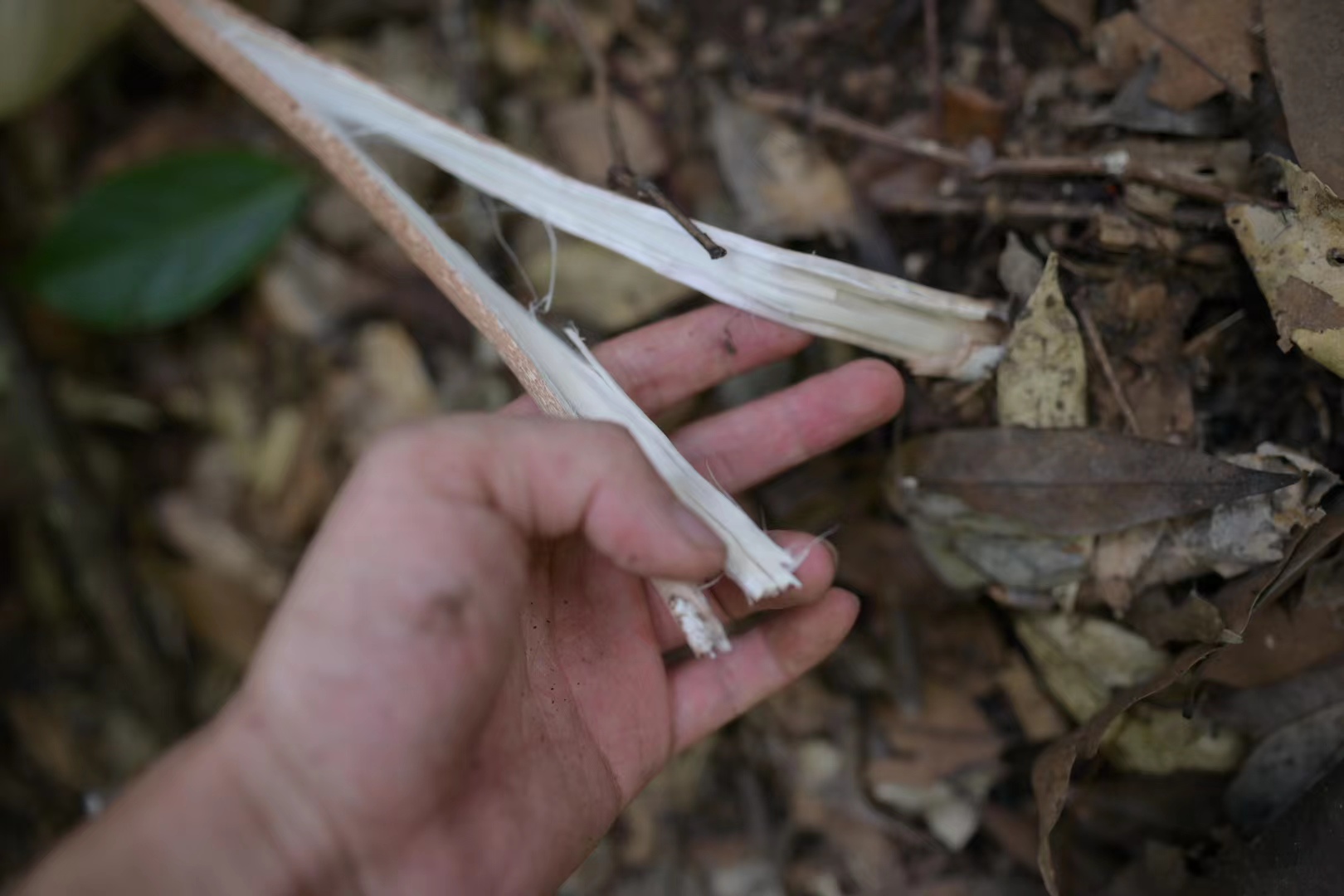
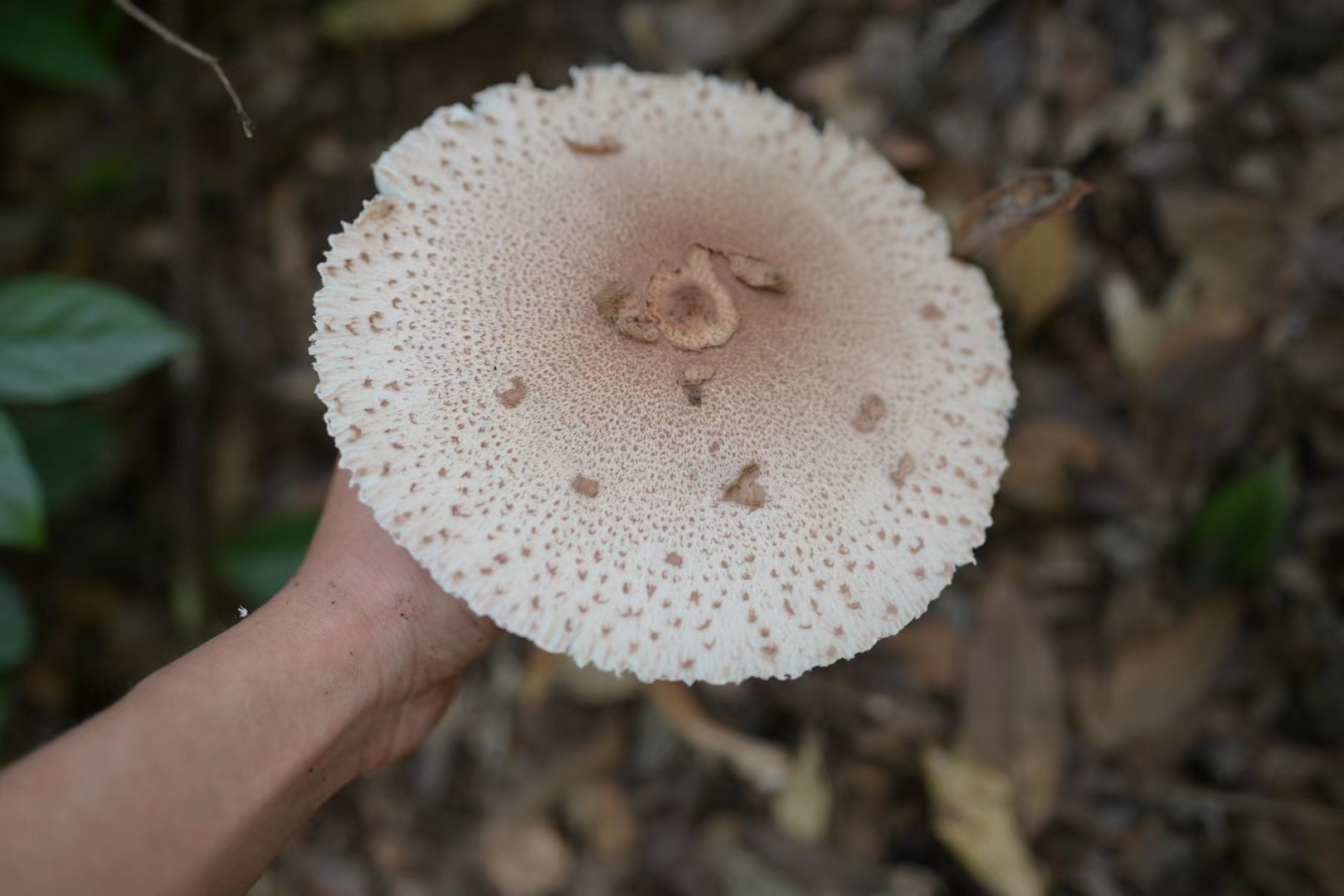
Pileus 120–220 mm, when young globose to subglobose, paraboloid, expanding to campanulate, convex, umbonate or not, sometimes slightly depressed at the center, when young completely brown (6E5), later covering broken and with dark brown, irregular calotte (6F4–8; Mu. 7.5 YR 5/4, 6/6) at the center, with concolorous big patches and squamules around calotte toward the margin, patches fragile when mature; background radially fibrillose and light to greyish-brown (6D3–5; 10 YR 7/4–7.5 YR 8/6–4), slightly squarrose especially in the outer part, where the fibrils are more spread out and show the white background in between; margin irregular and exceeding lamellae. Lamellae, L = 80–130, l = 0 or 1, moderately crowded to crowded, free and remote (up to 4 mm) from stipe, off-white, broad and ventricose, up to 12 mm wide, with white floccose (cystidiose) edge. Stipe 130–350 × 7–10 mm at apex, 10–18 mm wide in the center, cylindrical or slightly widening downward, 23–30 mm wide at base; base in some specimens bulbous; completely covered in brown tomentose-velvety light-brown to brown, or reddish-brown (6D4–5, 6E5–6, 7.5 YR 7–6/6) covering, which breaks open into small very fine to fine horizontal bands that can form zig-zag patterns, hollow with central white cottony strand, protruding into pileus. Annulus a white descending or ascending cuff, and a flaring double part, white to yellowish-white (4A2) membranous on the upper side with a fringed edge; underside with squamules as on pileus; movable with age. Context thick and soft, white and dull in pileus; in stipe buff and hollow. Smell fungoid. Taste not observed. Spore print white.
Basidiospores [90,3,3] 11.8–16.5 × 8.3–13.5 µm, avl × avw = 13.2–15.3 × 9.2–11.2 µm, Q = 1.2–1.51, avQ = 1.3–1.45, in side-view broadly ellipsoid to ellipsoid, with germ pore covered by the hyaline cap, thick-walled, hyaline to pale-yellow, dextrinoid, congophilous, metachromatic. Basidia 30–40 × 11–19 µm, clavate, slightly thick-walled, 4-spored, rarely 2-spored, with basal clamp-connection. Lamella edge sterile. Cheilocystidia in chains of up to 5 elements; terminal elements 7–40 × 7–30 µm, variable in size and shape, usually subglobose, occasionally clavate, with rarely cylindrical, hyaline. Pleurocystidia not found. Pileus covering at umbo and calotte a hymenoderm made up of hemispherical to cylindrical elements, thick-walled, hyaline to pale-brown, 20–92.5 × 10–12.5 µm. Stipe covering a hymeniderm made up of cylindrical elements and hyphae, 8.7–15 µm wide. Clamp-connections at the base of basidia and cheilocystidia.
Habitat and distribution: growing solitary to small group, saprotrophic, and terrestrial in half-open forests and on the edge of grasslands; known from Chiang Mai province of northern Thailand and Oudomxay province of North Laos.
Material examined: Thailand, Chiang Mai Province, Mae Taeng District, Pha Deng Village, 25 June 2007, E.C. Vellinga 3553 (UC); ibidem, 3 July 2007, R. Walleyn (coll. E.C. Vellinga 3599) (UC); ibidem, 28 September 2008, P. Sysouphanthong (MFLU 09-0203); ibidem, 20 June 2009, P. Sysouphanthong and J.K. Lui, BJP0023, culture (MFLUCC 10-0369); Chiang Mai province, Mae Taeng District, Pongduad Village, 22 June 2009, P. Sysouphanthong and J.K. Lui, BJP0029, culture (MFLUCC 10-0375). Laos, Oudomxay Privince, Xay District, Houy Houm Village, 30 June 2014, P. Sysouphanthong, PS2014-260 (HNL501921); ibidem, 16 July 2014, P. Sysouphanthong, PS2014-437 (HNL502108); ibidem, 05 August 2014, P. Sysouphanthong, PS2014-648 (HNL502319).
Notes: Macrolepiota excelsa is a new species found in northern Thailand and northern Laos. Macroscopically this species resembles M. procera (Scop.: Fr.) Singer very much in general appearance, but it differs in the brown, not grey-brown, colors on pileus and stipe. The ITS sequence, however, does not place this species in the vicinity of M. procera, but closely related to M. detersa, M. dolichaula, the Australian sequestrate species M. turbinata T. Lebel, and M. aberdarensis Mbaluto and Otieno from Kenya (Figure 4). Macrolepiota detersa differs in brownish-orange to light-brown squamules on pileus and yellowish-white background, the very well-developed hanging annulus, and the branched cheilocystidia (Figure 15 and Figure 16); the holotype from China showed more clavate to broadly clavate to pyriform and rarely subfusiform cheilocystidia [58]. The pileus of M. dolichaula is much lighter colored with small brown squamules on a white background, and more clavate to sphaeropedunculate cheilocystidia (Figure 19 and Figure 20). Macrolepiota aberdarensis, a species resembling M. dolichaula, is distinghuised from M. detersa by the lighter color of squamules on pileus and white background and the cheilocystidia not arranged in chains [70]. Another species in the same clade, Macrolepiota umbonata H. J. Cho, H. Lee, and Y.W. Lim, described from South Korea differs from M. excelsa by the distinct umbo on the pileus, the white background of the pileus surface, and superior and non-membranous annulus [59].
The stipes of M. excelsa have a central cord, similar to the stipes of Coprinus comatus (O.F. Müll.: Fr.) Pers. and Montagnea arenaria (DC.) Zeller [72]. This is the first report of this feature outside the Coprinus comatus clade.
参考翻译:
Macrolepiota excelsa Vellinga, Sysouph., Thongkl. and K.D. Hyde 新物种
Mycobank编号:MB 838685; Facesoffungi 编号: FoF 09700;
词源学:拉丁种加词‘excelsa’意为“高的、高耸的、显眼的”。
主要特征:Macrolepiota excelsa的标志性特征是其大的,褐色至深褐色菌盖,离生白色的菌褶,褐色至深褐色,圆柱形菌柄,白色膜质菌环,宽椭圆形至椭圆形孢子,有1芽孔,囊状至窄棒状褶缘囊状体,膜皮形(由子实层状排列细胞组成的)菌盖表皮,由棒状至圆柱形元素组成。
模式标本:ecv3572 (UC).
菌盖宽120-220mm,幼年球形至近球形,抛物面形,开展至钟形至凸镜形,中部凸起或不凸起,有时中部略下凹,幼年纯褐色,一段时间后表面覆盖无开裂,在菌盖中部形成深褐色边缘不规则的“小帽”,周围有同色的大块鳞片,鳞片成熟后脆弱易脱落;菌盖本身有辐射状纤维,淡褐色至灰褐色,略呈糠麸状,尤其在边缘纤维更稀疏、露出菌盖本底的地方更为明显;边缘不规则,超出菌褶。菌褶80-130片,2片菌褶间有0-1片小菌褶,略密集至密集,离生,距离菌柄4mm,米白色,宽,腹鼓状,中部宽达12mm,边缘呈白色卷毛状(因为排列有囊状体)。菌柄130–350 mm,顶端7-10mm、中部10-18mm宽,圆柱形或略向下变粗,基部23-30mm宽;一些样本基部球状膨大;整个菌柄被褐色、淡褐色、红褐色柔毛至绒毛,开裂成非常细小至细小的水平环带,在菌柄上形成锯齿状花纹;空心,中部有一根棉质纤维,一直伸入菌盖中。菌环白色,易脱落,袖口状,双层,上表面白色至黄白色,膜质,边缘流苏状,下表面有同菌盖的鳞片;老化后可上下移动。菌肉厚,软,菌盖中白色;菌柄中淡黄色,中空。气味蘑菇味。口味未知。
担孢子[90,3,3] 11.8–16.5 × 8.3–13.5 µm, 平均长宽 = 13.2–15.3 × 9.2–11.2 µm, 长宽比Q = 1.2–1.51, 平均长宽比avQ = 1.3–1.45,侧面观宽椭圆形至椭圆形,芽孔有透明盖,厚壁,透明至淡黄色,类糊精质,遇刚果红变红,内壁遇甲酚蓝变红。担子30–40 × 11–19 µm,棒状,略厚壁,4小梗,罕2小梗,基部有锁状联合。菌褶边缘不育。褶缘囊状体链状,可达5个细胞,末端细胞7–40 × 7–30 µm,形状大小多变,通常近球形,偶尔棒状,罕圆柱形,透明。侧生囊状体未见。盖表中部的鳞片由近子实层状排列的细胞组成,细胞半球形(
#原描述如此,但在配图中未见半球形的细胞。很难想象菌盖鳞片中的半球形细胞是什么样子。或许是打错了?——网站作者注)至圆柱形,厚壁,透明至淡褐色,20–92.5 × 10–12.5 µm。菌柄表皮由子实层状排列的细胞和菌丝组成,细胞圆柱形,菌丝宽8.7–15 µm。锁状联合在担子和褶缘囊状体基部可见。
生境和分布:腐生,单生或少量群生于地表,半开森林中,以及草地的边缘处;已知在泰国北部清迈府和老挝北部乌多姆塞省有分布。
讨论:Macrolepiota excelsa是一个泰国和老挝北部的新物种。宏观上这个物种和高大环柄菇M. procera在总体形态上很相似,但区别在于本种的菌盖和菌柄褐色调而非灰褐色调。ITS序列并未将这个物种置于高大环柄菇附近,而是置于脱皮大环柄菇M. detersa、长柄大环柄菇M. dolichaula、澳大利亚的一个腹菌化物种M. turbinata和肯尼亚的M. aberdarensis Mbaluto & Otieno (
#此物种学名应为M. aberdarense——网站作者注)附近。脱皮大环柄菇菌盖黄白色,有橙褐色至淡褐色鳞片,菌环发达下垂,褶缘囊状体分支;来自中国的模式标本表现了更多棒状、宽棒状至梨形,罕有近纺锤形的褶缘囊状体。长柄大环柄菇的菌盖颜色浅很多,菌盖白色,有小的褐色鳞片,褶缘囊状体更多呈棒状至球头短柄状。M. aberdarensis,一个和长柄大环柄菇相似的物种,和脱皮大环柄菇的区别在于其菌盖鳞片颜色更淡,菌盖白色,褶缘囊状体不呈链状。另一个在同一分支中的物种,凸顶大环柄菇
M. umbonate,原描述于韩国南部,和本种的区别是其菌盖上有明显的凸起,菌盖本底白色,上位非膜质的菌环。
本物种的菌柄有一根中心纤维,和毛头鬼伞Coprinus comatus、蒙塔假菇Montagnea arenaria的菌柄类似。这是第一次在毛头鬼伞近缘种以外的地方报道此特征。