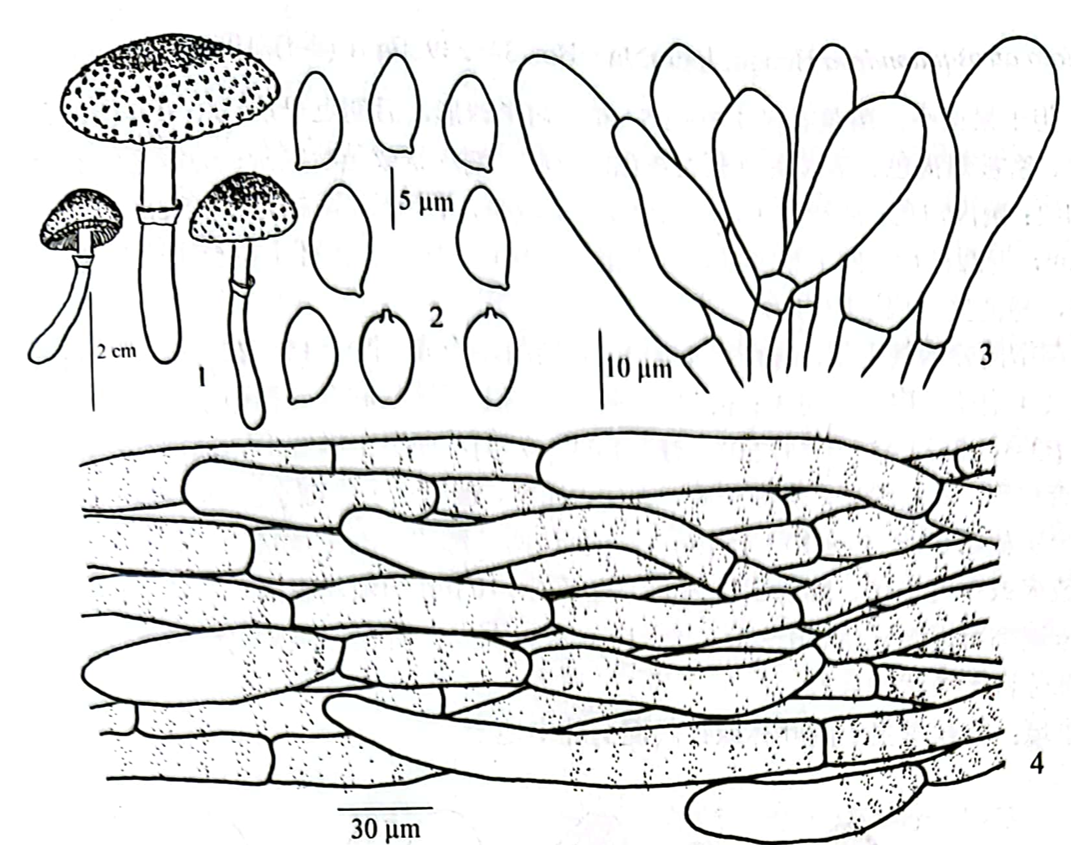
Leucoagaricus atroazureus J.F. Liang, Zhu L. Yang &J. Xu, sp. nov. FIG.2
MycoBank MB515456
Pileus albidus, cremeus vel griseo-aurantiacus, medioatropurpureo vel brunneo-rubro; margine sordide albida,striata vel non-striata; squamulis atrobrunneis, atrocyanes-centibus. Stipes subcylindricus, subglabrus, initio albus vel cremeus, deinde pallide-flavus vel brunneus. Caro alba, inatroazureum transit si contundatur. Basidiosporae 5.5–8.5×3.5–5.0 mm, amygdaliformes. Cheilocystidia angusticlavatavel clavata. Pleurocystidia nulla. Squamulae pilei ex hyphiscylindricis terminalibus compositae. Fibulae absentes.
Holotypus. Zhu L. Yang 3695(HKAS 42670), 16 Jul2003, Near Xima, Yingjiang County, Yunnan Province,China.
Etymology.Named because of the dark blue reactionof basidiomata where bruised or dried.
Basidiomata(FIG. 2A).Pileus 1.6–4.5 cm diam,convex, slightly umbonate, center black-red (10C8)to brownish red (11C7–8), elsewhere with whitish tocream to grayish orange (6B3–5) ground, andcovered with reddish brown (9D7–8) to dark brown(6F7–8) squamules; margin dirty white, striate in age.Contextthin to moderately thick, 1–2 mm, white butbecoming dark blue where bruised or dried.Lamellae free, white to cream to yellowish (2A2), crowded,lamellulae present.Stipe2–4 cm 32–6 mm, silky-fibrillose or nearly glabrous, not brittle, attenuate,occasionally inflated or narrowed toward the base,fistulous, surface at first white to yellowish (2A2),becoming grayish orange (6B4–5) when mature,becoming dark blue when bruised or dried.Annuluswhite but becoming dark blue when dried, edgebrownish red (11C7–8), fragile, superior, about 5 mm below the apex of stipe, sometimes disappearing.Odornone.Flavornot recorded.
Basidiospores(FIG. 2B) [185/9/5] (5.0–)5.5–8.0(–9.0)×(3.0–)3.5–5.0(–6.0) mm(Q=[1.25–]1.38–1.88[–2.00],
Q=1.61±0.15), amygdaliform in sideview, attenuate toward apex, ovoid in front view,without germ pore, hyaline, smooth, slightly thick-walled, dextrinoid, congophilic, metachromatic incresyl blue, with guttulate contents.Basidia 15–23 × 7–11 mm, clavate, four-spored, rarely two-spored,hyaline.Cheilocystidia(FIG. 2C) 22–50(–65) × 5–15 mm, clavate to narrowly clavate, sometimes fusi-form, thin-walled, hyaline, not abundant.Pleurocysti-diaabsent.Pileipellis(FIG. 2D) loosely arranged cutis of cylindrical hyphae; terminal elements barely differentiated, (17–)21–92(–115) × 6–20 mm, subcy-lindrical, occasionally narrowly clavate or fusiform,thin-walled, with pale brown intracellular pigmentsand often encrusted with brown pigments.Clampconnectionsabsent.
Materials examined: CHINA: Yunnan Provinve, YingjiangCounty (24u429320N, 97u559550E), near Xima, in forest ofPinus kesiyavar.langbianensis, 1700 m, 16 Jul 2003,Zhu L.Yang 3695(HKAS 42670, holotype); Changning County(24u499480N, 99u369180E), Bawancun, 2100 m, 17 Jul 2003,L.F. Zhang 184(HKAS 42470); Longling County(24u359230N, 98u419280E), Longxindaxueshan, 2300 m, 30Aug 2002,Zhu L. Yang 3371(HKAS 41440); HainanProvince, Ledong County, Jianfengling (18u239–18u509N,108u369–109u059E), 650 m, 14 Jul 2005,J.F. Liang 113(HKAS 48453); same location, 14 Jul 2005,J.F. Liang 110(HKAS 48450).
Habitat.Solitary on the ground in tropical andsubtropical forests.
Known distribution.Known only from southern andsouthwestern China.
Notes. Leucoagaricus atroazureusis characterized bywhite context, clavate to narrowly clavate cheilocysti-dia, absence of pleurocystidia and the dark bluechanges of basidiomata where bruised or dried. Thecolors can be observed on herbarium collections.
The species is similar toL. cyanescens,L. viridi-tincta,L. caerulescens and L. virescens Pat. with regardto bruising and white context. However L. cyanescens differs fromLa. atroazureus in having larger andwider basidiospores (8–10×37–8 mm) (Beeli 1927),L.viriditincta has orange fibrillose squamules on thepileus and broadly clavate cheilocystidia,L. caerulescens differs by the broadly clavate cheilocystidia and fleeting bluish tint and L. virescensPat. has brown andpulverulent squamules on pileus (Patouillard 1924).
Apart from the above,L. subcitrophylla,L.trichroma,La. sulphurellus,La. viridiflavoides and La. viridiflavus also exhibit bluish green bruising, butthese all have yellow or yellowish context. The newspecies La. flavovirens differs from La. atroazureus by its yellow or yellowish context and fusiform cheilocys-tidia with a short apical appendage.As mentioned above the blue or dark blue species(L. caerulea,L. cyanea,L. atrocoeruleaandL. azurea)also differ from this new species by original blue ordark blue in context or squamules (Beardslee 1915,Rick 1920, Singer and Digilio 1952) while L.cyanozonata turns brownish tan from pale blue whendry (Longyear 1902).
变蓝白环蘑 图75
Leucoagaricus atroazureus J.F.Liang,Zhu L. Yang & J.Xu, Mycologia 102: 1144, fig.2, 2010.
担子果小型。菌盖直径1.6~4.5cm,初平凸形,后渐伸展;菌盖中央具不明显黑红色至褐红色凸起,其他地方污白色、奶油色至淡灰橙色并被有红褐色至暗褐色鳞片:菌盖边缘污白色,老后具沟状条纹;菌肉厚 1~2mm,白色,受伤或干燥后变为暗色;菌褶离生,白色、乳白色至浅黄色,密,不等长。菌柄长 2~4 cm,直径 0.2~0.6 cm纤维状或近光滑无毛,向顶部渐细,中空,基部略膨大或略缢缩;初白色、米色至浅黄色,成熟后变为浅灰橙色,受伤或干燥后变暗蓝色;菌环上位,生于距柄顶端约5mr处,白色,边缘浅褐红色,干燥后呈暗蓝色,易脱落。无气味。
担子15~23x7~11μm,棒状,具4孢梗,偶具2孢梗,无色透明。担孢子(5)5.5~8(9)x(3)3.5~5(6)um[Q=(1.25)1.38~1.88(2.00),
Q=1.61±0.15],侧面观杏仁形,向顶部渐变窄,背腹观卵圆形,无芽孔,无色透明,光滑,壁略厚,类糊精质,刚果红中红褐色,甲酚蓝中变红色。褶缘囊状体较少,22~50(65)x5~15μm,棒状至窄棒状,有时纺锤状,薄壁,无色透明。侧生囊状体阙如。菌盖表面鳞片由呈毛状排列的菌丝组成,但菌丝在生长过程中常倒伏,末端细胞(17)21~92(115)x6~20μm,无明显分化近圆柱状,偶呈窄棒状至纺锤状,具淡褐色胞内色素及褐色胞外色素。锁状联合阙如。
生境:夏季生于热带和南亚热带林中地上。
世界分布:亚洲(中国)。
模式产地:中国(云南)。
研究标本:中国:海南:乐东,尖峰岭,沟谷雨林,海拔650m,2005年7月14日,梁俊峰110(HKAS48450);同地,海拔650m,2005年7月14日,梁俊峰113(HKAS48453)。云南:龙陵,大雪山,海拔2300m,2002年8月30日,杨祝良3371(HKAS41440)隆阳,坝湾村,海拔2100m,2003年7月17日,张丽芳184(HKAS42470);盈江,昔马,海拔1700m,2003年7月16日,杨祝良3695(HKAS 42670,主模式)
讨论:变蓝白环蘑La.atroazureus菌盖表面白色至米色,被有红褐色至暗褐色鳞片,受伤或干燥后变为暗蓝色,褶缘囊状体棒状或窄棒状,无侧生囊状体。
该种近似于蓝化白环蘑La.caerulescens,区别在于后者虽受伤也变蓝色,但蓝色不持久,很易消失,褶缘囊状体宽棒状。变蓝白环蘑与 La.viriditinctus的区别在于后者的菌盖表面鳞片呈纤丝状,褶缘囊状体宽棒状(Pegler,1972,1977,1983,1986)。变蓝白环蘑与变绿白环蘑La.flavovirens的区别在于后者担子果黄色或浅黄色,受伤变为深绿色,褶缘囊状体纺锤状且具指状至乳头状凸起(Liang et al,2010)。变蓝白环蘑与L. cvanescens Beeli的区别是后者的担孢子较大且宽(Beeli,1927),与L.virescens Pat.的区别在于后者的菌盖表面鳞片呈褐色、粉状(Patouillard,1924)。