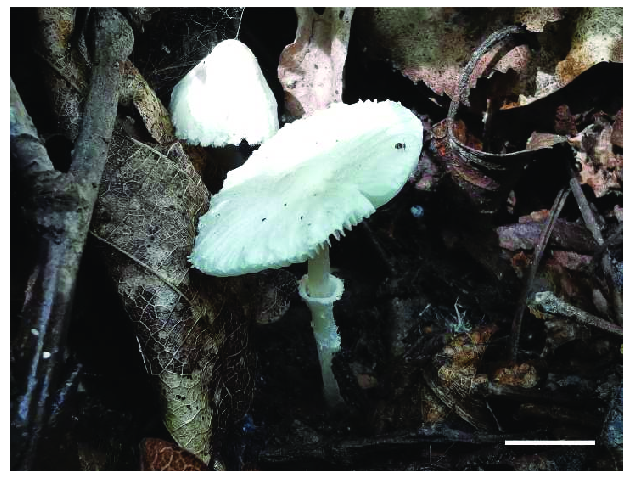
Leucoagaricus candidus Y.R. Ma, Z. W. Ge & T.Z. Liu, sp. nov. Figure 8 and Figure 9.
MycoBank: MB 843379
Etymology: candidus (Latin) = white, referring to the almost snow white basidiomata.
Diagnosis: Leucoagaricus candidus is characterized by its white basidiomata, white pileus squamules, a margin often with appendiculate white veil remnants and ellipsoid to broadly ellipsoid basidiospores.
Type: CHINA. Inner Mongolia Autonomous Region: Sidaogou, Heilihe National Nature Reserve, Ningcheng County, Chifeng City, 21 August 2019, T.Z. Liu, K. Kang (CFSZ 20964, holotype).
GenBank Acc. No.: ITS = OM976877, LSU = OM976864
Description: Pileus 15–31 mm in diameter, white (1A1), ovoid when young, becoming convex to applanate with age, glabrous to radially fibrillose, margin often with fine striations when mature, appendiculate with veil remnants. Context: white (1A1), thin, no change in color upon bruising. Lamellae-free, crowded, white (1A1), up to 3 mm in height, edge finely scalloped. Stipe, 27–38 × 3–7 mm, subcylindrical, white (1A1), clavate, hollow, white (1A1) to milk white (1A2), smooth to silky above annulus, with white, minute or fibrillose squamules below annulus. Annulus white (1A1), membranous, located in the middle to upper part of the stipe. Flavor and odor unknown. Spore print not recorded.
Basidiospores [62/5/3], (5.5)6.0–7.5(8.0) × (4.0)4.5–5.0 μm; Q = (1.20)1.33–1.63(1.78), Qm = 1.46 ± 0.13; ellipsoid in side view, occasionally broadly ellipsoid or elongate; ellipsoid in front view; without germ pore, hyaline, slightly thick-walled (about 0.5 μm); dextrinoid, metachromatic in Cresyl Blue. Basidia, 16.0–20.5 × 7.0–9.5 μm, clavate, hyaline, four-spored. Cheilocystidia, 29.0–42.0 × 8.0–12.5 μm, mostly narrowly clavate, occasionally with a constricted apex. Pleurocystidia, absent. Lamellar trama, trabecular. Pileus surface composed of 5.0–13.0 μm wide repent-hyphae, subcylindrical, thin-walled, hyaline. Stipitipellis composed of subcylindric hyphae, 4.0–8.5 μm in width with yellowish intracellular pigment. Clamp connections absent in all parts of the basidiomata.
Habitat and Habit: solitary to scattered on soil in summer.
Other specimens examined: CHINA. Inner Mongolia Autonomous Region: Daheishan National Nature Reserve, Aohan Banner, Chifeng City, 22 August 2016, T.Z. Liu, S.L. Zhang, Y.X. Yang (CFSZ 11287). Inner Mongolia Autonomous Region: Sidaogou, Heilihe National Nature Reserve, Ningcheng County, Chifeng City, 22 August 2019, T.Z. Liu, T. Li (CFSZ 20991).
Comments: Leucoagaricus candidus is morphologically similar to Leucoagaricus nivalis, Leucoagaricus serenus (Fr.) Bon & Boiffard and Leucoagaricus sericifer on the overall whitish to white basidiomata. However, La. candidus differs from them by having ellipsoid to broadly ellipsoid basidiospores and a pileus surface composed of wider hyphae (5.0–13.0 μm). In addition, both La. serenus and La. sericifer were originally described in Europe and are widespread in Europe [6,31,35].
Two white European species, La. subvolvatus (Malencon & Bertault) Bon and La. menieri (Sacc.) Singer, are also similar to La. candidus in the overall white basidiomata and similar basidiospores. However, La. subvolvatus has white to cream pileus and cheilocystidia with crystals at the apex [32]; La. menieri has fragile and sericeous pileus and cheilocystidia with crystals at the apex [32].