从化层蘑菇Hymenagaricus conghuaensis
Kun L. Yang, Jia Y. Lin & Zhu L. Yang 2025
基本信息 | - 通用中文名Chinese name:从化层蘑菇
- 拉丁学名Scientific name:Hymenagaricus conghuaensis Kun L. Yang, Jia Y. Lin & Zhu L. Yang 2025
- 科family:蘑菇科Agaricaceae
- 属Genus:层蘑菇属Hymenagaricus
- 分布Distribution:中国
- 有分布的省区Provinces:广东省(文献记载)
查看具体分布情况 - 生态Ecology:亚热带季风森林中,土壤、苔藓丛上单生。
- 营养类型Nutrition Type:腐生Saprotrophic: 分解死亡生物体或有机物获取养分
- 置信指标Confidence:★★★
|
介绍部分
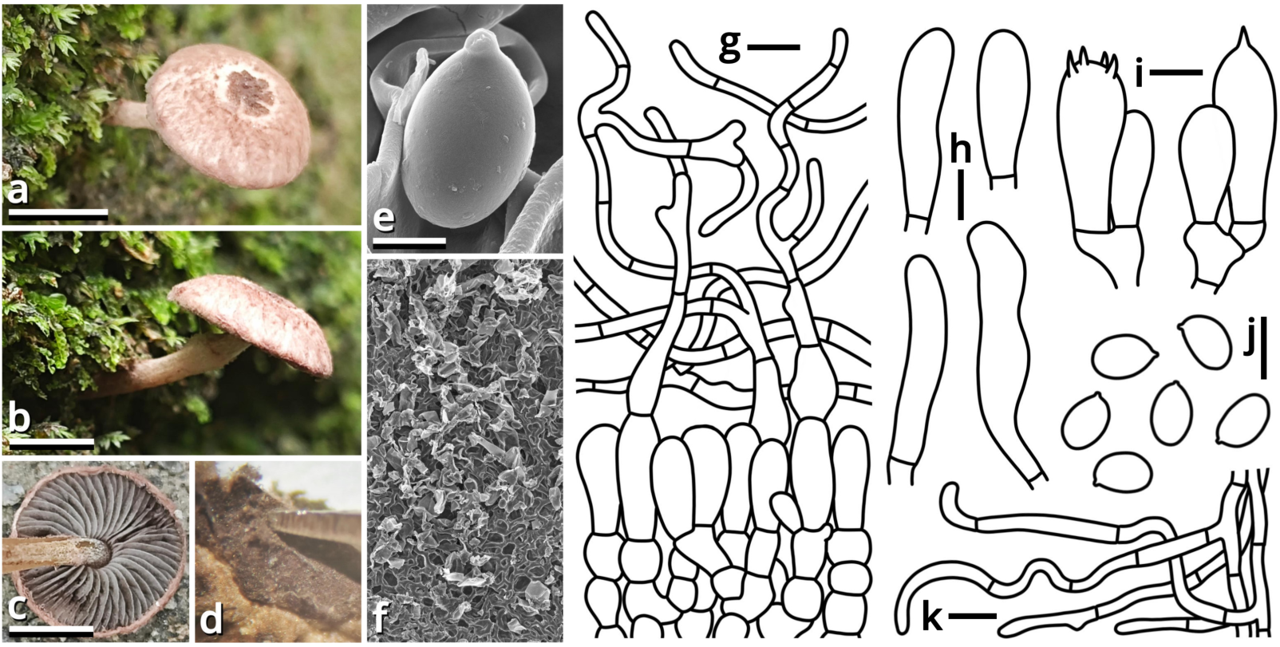
简介:从化层蘑菇是2025年发现于广州的层蘑菇属物种。主要特征是菌盖上被鳞屑状至纤维状的紫褐色鳞片;菌褶离生至弯生,土灰色至棕色;菌环易碎;担孢子4.5–5 × 3–3.5 µm,椭圆形,厚壁,光滑,棕色至深棕色;菌盖中部鳞片膜皮型至毛皮型,菌盖表面为棒状至近圆柱状膜皮型排列的细胞,这一层细胞上长出交织的菌丝,形成菌盖的鳞片。
该物种和华丽层蘑菇
Hymenagaricus splendidissimus近缘,区别在于菌褶和孢子无蓝紫色调,另外体型更小(菌盖仅约1cm宽),鳞片更稀疏。
涉及到该物种的相关文献
(能证明该种在我国有分布的文献)
- New and interesting fungi from Guangzhou City, South China, 2025. Kun L. Yang, Jia Y. Lin, Guang-Mei Li & Zhu L. Yang. Phytotaxa 707 (1): 001–095 https://doi.org/10.11646/phytotaxa.707.1.1
序列信息
如何下载序列?
| 分子类型 |
标本号 |
Version No. |
序列 |
文献 |
来源地 |
| DNA | HKAS 147741[主模式] | PV620889 | ITS | ↗ | 中国 广东省 Guangzhou City, Conghua District, Liuxi River National Forest Park on a moss land |
| DNA | HKAS 147741[主模式] | PV616969 | LSU | ↗ | 中国 广东省 Guangzhou City, Conghua District, Liuxi River National Forest Park on a moss land |
| DNA | HKAS 147741[主模式] | PV642282 | rbp1 | ↗ | 中国 广东省 Guangzhou City, Conghua District, Liuxi River National Forest Park on a moss land |
| DNA | HKAS 147741[主模式] | PV642294 | rbp2 | ↗ | 中国 广东省 Guangzhou City, Conghua District, Liuxi River National Forest Park on a moss land |
| DNA | HKAS 147741[主模式] | PV642311 | tef1 | ↗ | 中国 广东省 Guangzhou City, Conghua District, Liuxi River National Forest Park on a moss land |
物种描述
以下描述摘自相关参考文献,仅供参考。可能存在文献过时、描述错误或者描述片面等情况
文字识别时可能有纰漏,描述若与参考文献原文有出入以原文为准
外文描述的参考翻译系网站管理者的个人翻译,仅供参考,具体以原文为准
描述1 描述来源:New and interesting fungi from Guangzhou City, South China类型:原白(物种发表时的原始描述)
描述原文:
Hymenagaricus conghuaensis Kun L. Yang, Jia Y. Lin & Zhu L. Yang, sp. nov. (Figs 5–6; Table 4; Supplements 2and 5)
Registration identifier FN572704
Etymology:—Referring to the type locality.
Diagnosis:—Differing from other Asian Hymenagaricus species by a combination of purplish brown pileus
squamules flaky and slightly felty at center, becoming fibrous towards margin, and ellipsoid basidiospores sized 4.5–5× 3–3.5 µm.
Type:—CHINA. Guangdong Province: Guangzhou City, Conghua District, Liuxi River National Forest Park,on a moss land, 23°45’17”N, 113°46’56”E, elevation 200 m, June 20, 2024, Kun L. Yang & Jia Y. Lin, K24041(HKAS147741, holotype (ITS: PV620889; nrLSU: PV616969; rpb1: PV642282; rpb2: PV642294; tef-1α: PV642311);HTBM2031, isotype).
Description:—Basidioma small; odour fungal; taste unknown. Pileus 11 mm in diameter, plano-convex;background ceramic white (#FEFEFA); squamules flaky and slightly felty at center, becoming fibrous towardsmargin, merino white (#F9F5EC), meat brown (#D7B19D) to beaver brown (#9D7B69), becoming lighter towardsmargin. Lamellae adnexed to free, nearly crowded, medium grey (#E0DEDD), muddy grey (#938F89) to flint brown(#736960), with a slightly serrate edge, interspersed with abundant lamellulae. Stipe 18 mm long, 1.5 mm thick,cylindrical, slightly curved; background merino white (#F9F5EC) to mist brown (#DCD8C9); squamules fibrous,merino white (#F9F5EC); context turning darker and reddish after damaged. Annulus superior, fibrous and fugacious,concolorous with the squamules on the stipe.
Basidiospores {40/1/1} (4) 4.5–5 [4.63 ± 0.27, 4.50] × 3–3.5 [3.23 ± 0.25, 3.00] µm, Q = 1.29–1.67 [1.44 ± 0.13,1.50], ellipsoid, slightly thick-walled, smooth, tinged cotton brown (#D2CAAD) to dark heather brown (#9D917B),with a small apiculus, with an indistinct germ pore. Basidia 16–18.5 × 5–7 μm, clavate, one-, two-, three- or four-spored, thin-walled, nearly colourless. Lamella trama regular to subregular, composed of 3–11 µm wide, thin-walled,nearly colourless, compact, moderately to frequently branching hyphae. Cheilocystidia abundant, 12–26 × 3–6 µm,clavate to subcylindrical, sometimes flexuous, thin-walled, smooth, nearly colourless. Pleurocystidia absent. Pileussquamules composed of a hymeniderm to trichoderm at center, becoming an entire trichoderm towards margin,by slightly thick-walled and encrusted, interwoven hyphae 2–8 µm wide issued from a lower layer of clavate tosubcylindrical cells measured 13.5–24 × 6.5–11 µm standing on subglobose cells measured 11–17 × 10–17 µm, tingedblush red (#D9B7B4). Stipe squamules composed of a trichoderm by 2.5–4 µm wide, thin- to slightly thick-walled andencrusted hyphae, tinged light cardamon yellow (#E9E9AD). Clamp connections occasionally present in the pileussquamules, absent in the other tissues.
Habit and distribution:—Solitary, on soil, in southern subtropical monsoon forests. Currently known fromChina.
Phylogeny:—According to the BLAST search of ITS sequence in GenBank (NCBI 2025), our collectionHKAS147741 is a species of Hymenagaricus. Therefore, a phylogeny was inferred to classify our collections withrepresentative collections of known species of Hymenagaricus and HKAS147741 as the ingroup, and two collectionsof Coniolepiota as the outgroup according to our recent study on phylogeny of Agaricaceae (Yang et al. 2024a), usingtwo loci (ITS and nrLSU) available for most species in this group (Table 4; Supplement 5). In the result, the ML and BItopologies are almost identical, only with a minimal variation in statistical support, so only the tree inferred from theML analysis is displayed (Fig. 5). The genus Hymenagaricus is resolved into five distinct groups, and our collectionHKAS147741 forms an undescribed clade sister to Hy. splendidissimus with significant support.
Notes:—The genus Hymenagaricus is typically characterized by brownish basidiospores and pileus squamuleswith a more or less hymeniform structure (Heinemann 1981, Heinemann 1985, Heinemann & Little Flower 1984).Watling (1999) proposed a new genus Heinemannomyces to accommodate a species similar to Hymenagaricus butwith floccose squamules, called He. splendidissimus. Yang et al. (2024b) found hymeniform structure beneath thefloccose squamules, explained He. splendidissimus as a modified Hymenagaricus species with outgrowing hyphaeon squamules, and synonymized Heinemannomyces to the earlier name Hymenagaricus with the new combinationHymenagaricus splendidissimus.
According to the current phylogeny (Fig. 5), the new species Hy. conghuaensis proposed here, is a species mostclosely related to Hy. splendidissimus ever known. It also exhibits outgrowing hyphae on the central squamule onpileus, generally similar to Hy. splendidissimus, but the squamules are fewer and sparser, the basidioma size is smaller,and the greyish brown lamellae and brownish basidiospores are different.
库中图片 1 张
标签:[无]
上次编辑:2025-11-09
物种编号:1053
Revised:true
本页向外链接的参考文献:总计 2 条链接(含重复)
重定向至本页的页面:总计 0 条链接
©菌物志Mycopedia
回到首页 搜索物种 目录
©菌物志Mycopedia,版权声明
如需引用本文可参考下列格式:
蔡佳铭.2025. 从化层蘑菇Hymenagaricus conghuaensis. 菌物志Mycopedia. http://www.mycopedia.top/result.php?details=Hymenagaricus conghuaensis
Jia-Ming Cai.2025. Hymenagaricus conghuaensis [Chinese]. Mycopedia. http://www.mycopedia.top/result.php?details=Hymenagaricus conghuaensis